
Nothing here asks to be taken on trust
How we compute
Every date on this site comes from NASA JPL DE440s ephemeris positions, reduced to sidereal signs with the Lahiri ayanamsa, the standard adopted by the Indian Calendar Reform Committee. Sade Sati is computed from the natal Moon per Phaladeepika 26.1; the Saturn return is computed from natal Saturn. Retrograde re-entries are reported as separate periods rather than smoothed into one block, and where our computed figure differs from the commonly quoted one, we publish the computed figure and say so. This page names every source so the output can be checked rather than believed.
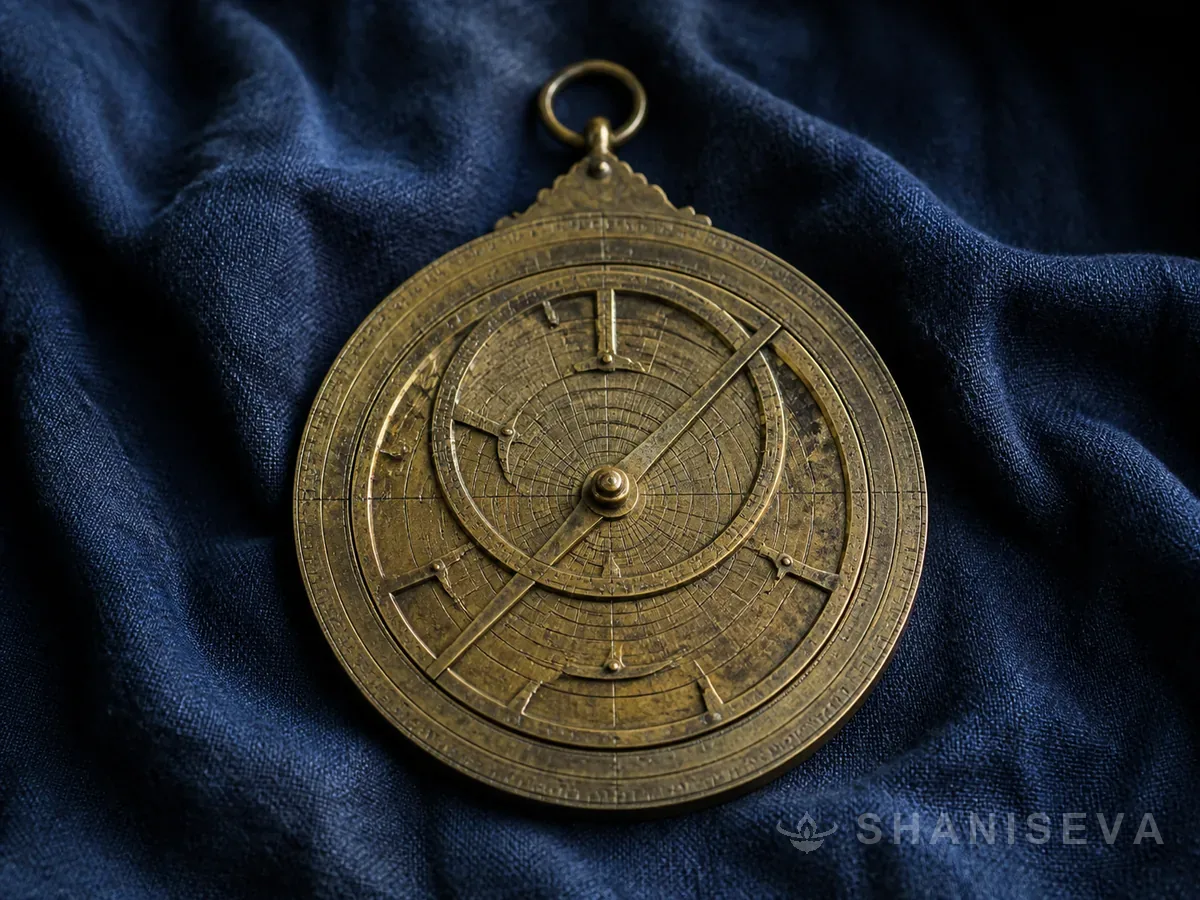
The ephemeris

Planetary positions come from the DE440s ephemeris published by NASA's Jet Propulsion Laboratory. It is the same data used for spacecraft navigation, and it is the reference standard for solar system positions.
Saturn's ingresses - the moments it crosses from one sign into the next - are precomputed from that data and stored, so no astronomy runs while you wait for a page. The stored table covers 1902 to 2099 for Saturn and 1900 to 2099 for the Moon, which bounds what the calculators can honestly answer. Ask for a birth date outside that window and you are told we cannot compute it, rather than given a number.
The ayanamsa, and why it matters

Western astrology uses the tropical zodiac, anchored to the equinox. Vedic astrology uses the sidereal zodiac, anchored to the fixed stars. The two have drifted apart by roughly 24 degrees since they last coincided, because of the precession of the equinoxes, and that offset is the ayanamsa.
Twenty-four degrees is most of a sign. It is why a person's Vedic rashi is frequently the sign before their Western sun sign, and why a calculation using the wrong zodiac produces confidently wrong answers rather than slightly imprecise ones.
We use the Lahiri ayanamsa, adopted by the Indian Calendar Reform Committee and used by the Rashtriya Panchang, the Indian national almanac. It is the standard for Vedic astrology in India, which is the tradition these pages sit inside.
What each calculator computes
| Sade Sati | Saturn return | |
|---|---|---|
| Measured from | Natal Moon | Natal Saturn |
| Covers | The 12th, 1st and 2nd signs from the Moon | Saturn back in its own birth sign |
| Doctrinal source | Phaladeepika 26.1 | Saturn's orbital period |
| Input needed | Moon rashi, or birth date | Birth date |
| Precision | Sign level | Sign level |
Sign returns, not degree-exact ones
This is the most important limitation on the site and it is stated on the calculator itself as well as here.
A degree-exact Saturn return - Saturn back at the precise longitude it held at your birth, to the day - requires a full natal chart, which requires your birth time and place. We do not generate natal charts. What we compute is a sign return: the periods when Saturn is back in the rashi it occupied at your birth.
That is exact, and it is a real answer, but it is a different answer from the one a chart-based tool gives. Calculators that take only a birth date and print a single exact date are performing arithmetic they do not have the inputs for. We would rather say what we compute than imply a precision we cannot stand behind.
Retrograde motion, reported not smoothed
Saturn appears to reverse direction for about four and a half months each year. It is not reversing; Earth is overtaking it on a faster inner orbit, and the backward drift is an effect of perspective.
The consequence for transit dates is real even though the motion is not. Saturn can enter a sign, turn retrograde, slip back into the previous sign, and re-enter months later. Most published tables merge these into one clean block.
We do not. A Sade Sati that genuinely paused and resumed is reported as two periods, because that is what happened, and a devotee is better served by an accurate answer than a tidy one. On the reference table you can see every one of these fragments across a century.
Computed figures, not folk figures
Where the two differ, we publish the computed one and name the difference.
| Quantity | Commonly quoted | Computed |
|---|---|---|
| Sade Sati duration | 7.5 years | Mean 7.36, range 6.9 to 8.0 |
| Saturn's orbital period | 30 years | 29.46 years (10,759.22 days) |
| Time in one sign | 2.5 years | About 29 months, varying |
| Retrograde re-entries | Usually merged | Reported separately |
Seven and a half is the name of the transit, taken from three signs at roughly two and a half years each. It is a good name and a rounded number. Publishing it as though it were a measurement would be reporting the label rather than the sky.
What we do not claim
A transit is a position of a planet. Nothing on this site predicts what a position will do in a particular life, because nothing can.
Shani is Karmaphaladata, the giver of the fruit of action: the tradition holds that he brings to result what has already been set in motion rather than inventing a fate and imposing it. That doctrine rules out the framing common elsewhere in this market - that a transit guarantees misfortune, or that an observance purchases an exemption. We compute dates. We do not issue verdicts, and we do not sell relief from one.
What happens to what you type
Nothing. Birth dates entered into either calculator are used to compute the answer in the same request and are never written to storage. There is no account, no cookie holding your chart, and nothing to delete later. A birth date is among the more personal things a visitor can type and there is no reason for us to keep it.
Sources
- Planetary positions: NASA JPL Solar System Dynamics, DE440s ephemeris. Saturn's mean sidereal period 10,759.22 days.
- Sade Sati doctrine - Saturn in the 12th, 1st and 2nd from the natal Moon: Mantreswara, Phaladeepika, chapter 26 verse 1.
- Sidereal reduction: Lahiri ayanamsa, adopted by the Indian Calendar Reform Committee and used by the Rashtriya Panchang.
- Dashrath Krit Shani Stotra: Padma Purana, Uttara Khanda chapter 33 - not the Bhavishya Purana, as is often stated.
- Shani Vajra Panjar Kavach: Brahmanda Purana.
Corrections
If a date here is wrong, we want to know, and we will say so on the page rather than quietly changing it. A method that cannot be corrected in public is not a method.
The tools this describes: Sade Sati calculator, Saturn return calculator, and the full reference table.