
Shani remedies
Sade Sati remedies
Sade Sati is the roughly seven-and-a-half year period during which Shani transits the sign before the natal Moon, the sign of the Moon itself, and the sign after it. It is one of the most discussed periods in Vedic astrology, and one of the most misrepresented. Before anything else, it helps to know who Shani Dev is understood to be - because almost everything written about this period gets that part wrong.
Who Shani Dev is, and why it changes everything
Shani Dev is Karmaphaladata - the one who dispenses the fruits of action. The tradition does not hold that he inflicts misfortune on a whim. It holds that he delivers what your own past actions have already earned, without partiality, and often long after the act, which is why the connection is so easily missed.
That single idea reorders everything else. He is not an enemy to be bought off; he holds an office, and he administers it. The Skanda Purana says he attained his station through his own penance, and the same passage locates a Shiva linga at Kashi associated with his worship - the one who enforces discipline is himself a devotee, and himself subject.
It follows that he cannot be bribed. Any offer to make Shani Dev leave you alone in exchange for money is incoherent on the terms of the tradition itself. What the tradition offers instead is stranger and better: you are asked to take up voluntarily the qualities the period would otherwise impose on you - patience, restraint, honest dealing, and service to those who have less.
It is worth adding that the canonical image of Shani Dev, as the Shilpashastra describes it, shows him standing with his right hand raised in abhaya-hasta - the gesture meaning "do not fear". A tradition that meant only to frighten you would not have carved that.
The three phases
Sade Sati is conventionally divided into three phases of about two and a half years each, named for where Saturn sits relative to the natal Moon.
The rising phase (Saturn in the twelfth sign from the Moon) is traditionally associated with expenditure, disturbed sleep and matters that drain rather than break. The peak phase (Saturn over the Moon itself) is the one most written about, and is associated in the texts with pressure on the mind and on health. The setting phase (Saturn in the second from the Moon) is associated with family and finances.
Classical sources differ on which phase is heaviest, and reputable astrologers disagree. Anyone who tells you with certainty what a phase will do to you is telling you more than the tradition itself claims.
What the tradition actually prescribes
The remedies handed down for Shani Dev are strikingly consistent, and strikingly undramatic. They are acts of discipline, service and restraint rather than transactions.
The items given are old and specific. The Padma Purana names iron, black sesame, oil-cakes, a black garment and a black cow; the Yajnavalkya Smriti and the Agni Purana give the same black cow, along with shami wood for the fire and offerings counted in 108s. Black cloth and black flowers follow from a rule that each planet receives its own colour.
Who those gifts should go to is a more interesting question than it first appears, and we would rather answer it honestly than tidily. In the classical texts the recipient is always a brahmin, for every planet alike - the tradition varies the gift, not the recipient. The now-common instruction to give Shani Dev's daan to the poor, to labourers, to the elderly and the disabled is a later reading, drawn from the fact that these are the very people the texts say he presides over. It is a humane reading, and we think a good one. But it is a reading, not a verse, and you will see it asserted as scripture all over the internet.
What the tradition is unambiguous about is that the giving is not a payment. The Bhagavad Gita is blunt that charity given in the hope of a return is the lesser kind. And the commentaries build in something the remedy market never mentions: where the prescribed gift is beyond your means, the texts say give what you can, even a trifle, according to capacity. An expensive remedy is not a more effective one.
It is worth noticing what the tradition does not prescribe: buying an expensive object, or paying a large sum to have anxiety lifted. Where you encounter that, it comes from the marketplace, not the texts. The classical gem literature, for instance, is entirely about valuation and detecting counterfeits - it assigns no stones to planets at all.
And the oldest answer of all is the least commercial one. Mantreswara closes the very chapter in which he sets out all of Shani Dev's difficult transits by saying that the planets are always favourable to one who does not injure others, who possesses self-control, who has earned his wealth by honest means, and who keeps to his discipline. That is the remedy the tradition puts last, in the place of emphasis. No one can sell it to you.
Where a puja fits
A Shani puja performed in your name is one part of this, not a substitute for the rest of it. It is a formal act of worship in which your name and gotra are stated in the sankalp - the declaration of who the ritual is being performed for, where, when, and why.
People sometimes ask whether a ritual performed for someone who is not present can really be theirs. It can, and this is not a modern convenience invented for the internet. In Vedic ritual the person who sponsors a rite and the person who performs it were already distinct roles: the yajamana sponsors and receives its fruit, while the ritvij priests carry it out on his behalf. Kings engaged priests to perform yajnas for them. The sankalp, naming you and your gotra, is precisely the mechanism that dedicates the rite to you.
Many people abroad ask us to perform it because they cannot get to a temple, or because the tradition is one they grew up with and want continued in their name. Both are honest reasons. Neither requires anyone to promise you an outcome.
What is traditionally done
- Til tel abhishek
- Abhishek with black sesame oil, the offering most consistently associated with Shani. Traditionally performed on a Saturday.
- Shani mantra jaap
- Recitation of the Shani mantra, most commonly in counts of 108 or multiples of it, over a set number of Saturdays.
- Deep daan
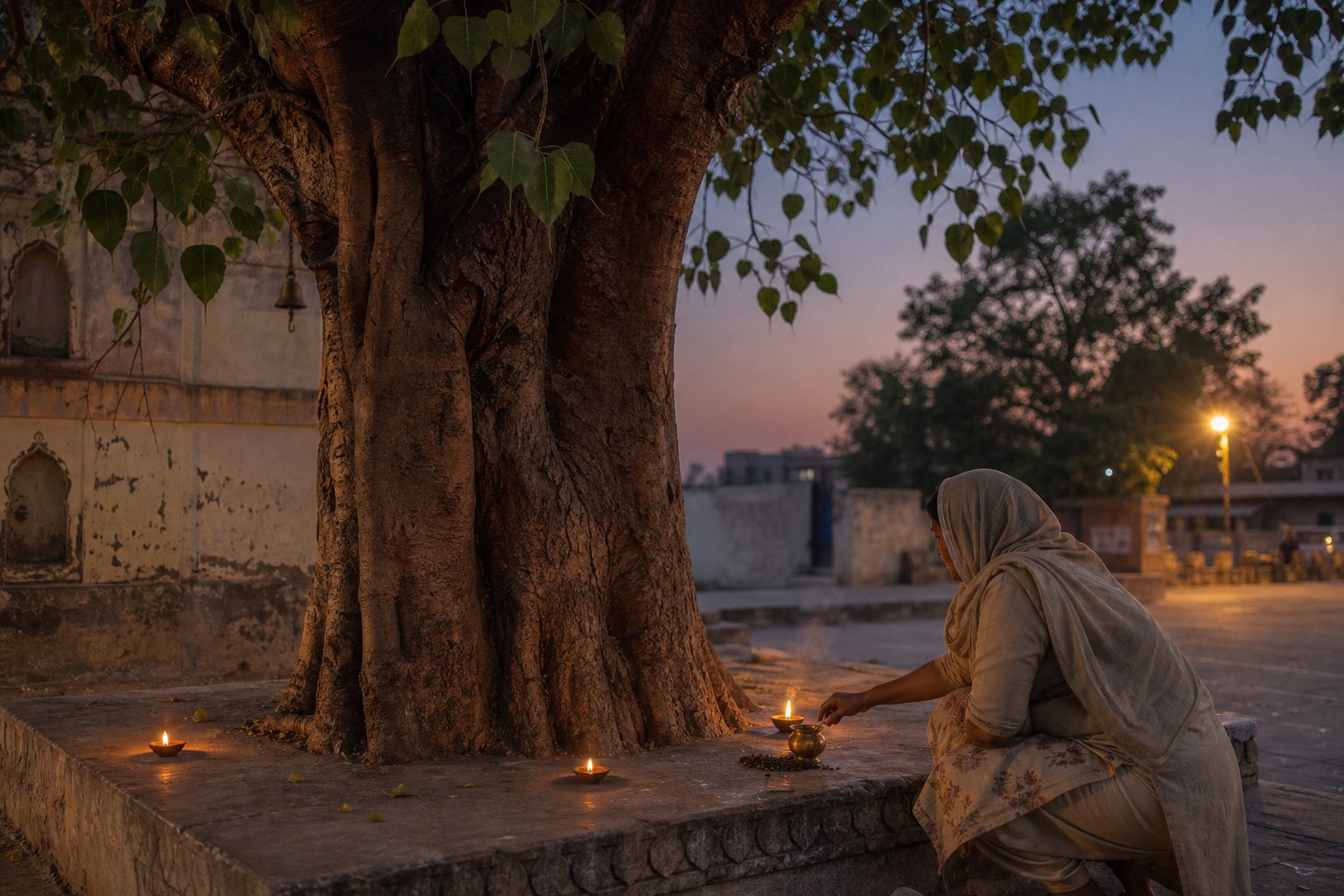
- The lighting and offering of lamps, customarily with sesame oil, in the evening.
- Anna and gau seva
- Feeding people and animals. Of all the remedies, this is the one the texts return to most often and the one that asks least of your wallet.
- Restraint
- Saturn is associated with discipline. Fasting on Saturdays, plain food, honest dealing and keeping your word are prescribed as remedies in their own right.
Questions we are asked
Can you tell me whether I am in Sade Sati?
No. We do not read charts and we do not diagnose. If you want to know, ask an astrologer you trust. We perform the seva you ask us to perform.
Will a puja end Sade Sati?
No, and anyone who says otherwise is selling you something. Sade Sati is a transit; it runs its course. The tradition offers remedies undertaken during it, not a way to switch it off.
Do I need to be present?
No. Your name and gotra are stated in the sankalp, which is what identifies the ritual as being performed for you. You receive a video of it afterwards.
What if I do not know my gotra?
That is very common in families abroad. The traditional practice is to use Kashyap gotra, and that is what we do unless you tell us otherwise. You are never asked to guess.