A Saturn return lasts between two and three years, not a single day. Saturn takes 29.46 years to complete one orbit and about 29 months to cross each sign of the zodiac, so the period in which it is back in the region of sky it occupied at your birth is measured in years. Saturn also turns retrograde for roughly four and a half months every year, which means it can enter your birth sign, leave it, and come back. The exact date most calculators return is the moment of precise conjunction, and it is one instant inside a much longer transit.
The distinction matters more than it sounds. Someone told their Saturn return falls on 14 March will watch that day, find it unremarkable, and conclude the whole thing was nonsense.
The one who was never in a hurry

The others are quick.
Chandra crosses a whole sign in two days and is gone before you have finished asking. Budha turns and turns again, restless, never settled in one place for long. Mangal comes at a run. Even Brihaspati, weighty as he is, clears a sign inside a year and moves on to bless somewhere else.
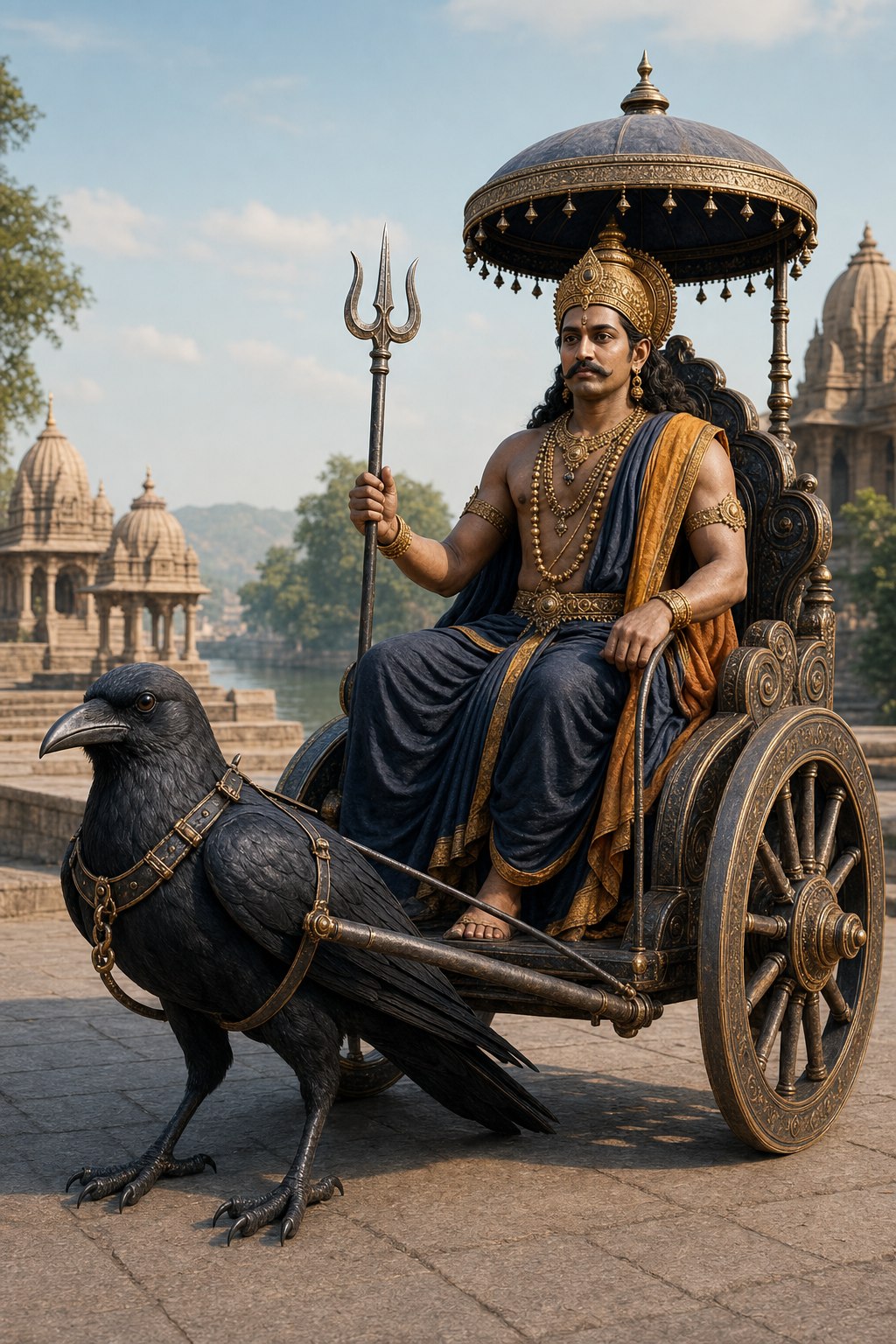
Shani takes twenty-nine and a half years to walk once around the sky.
The name they gave him says it before anything else does. Shanaischara. The slow-moving one. Not the fierce one, not the dark one, though he is both. The slow one.
Think about what that means for a god who keeps accounts. A quick planet arrives, does something to your year, and is gone before the thing it did has finished happening. You can wait it out. You can hold your breath.
You cannot hold your breath for two and a half years.
He does not arrive and depart. He arrives, and then he is simply there, month after month, in no hurry at all, while you go to work and come home and go to work again. He was there in the spring. He is still there in the autumn. He will be there next spring.
This is why the tradition never speaks of surviving Shani, the way you might speak of surviving a storm. A storm passes. Shani does not pass so much as accompany.
And because he is slow, he cannot be rushed, distracted, or waited out. He is the one planet you have to live alongside rather than endure.
Which turns out to be the whole answer to how long a Saturn return lasts. It lasts as long as it takes a very slow thing to cross a very wide sky.
Why the transit takes years
Saturn sits 1.4 billion kilometres from the Sun and travels its orbit at about 9.7 kilometres per second, which sounds fast until you consider the distance. From Earth, the planet appears to shift roughly one degree every twenty days.
The zodiac divides the sky into twelve signs of thirty degrees each. At one degree per twenty days, Saturn needs approximately 600 days, about 29 months, to cross one sign completely. If a Saturn return means Saturn back in the sign it held at your birth, the transit is by definition around two and a half years long.
Compare the Moon, which crosses a sign in roughly two and a quarter days, or the Sun, which takes a month. Saturn's slowness is precisely why both traditions treat it as the planet of structure, time and consequence. Fast planets are held to govern moods and days. Saturn governs the shape of a decade.
Retrograde motion, and why it stretches the window

Roughly once a year, for about four and a half months, Saturn appears to reverse direction and drift backwards against the stars. It is not actually reversing. Earth, on a much faster inner orbit, is overtaking it, and the apparent backward motion is the same effect you see when a slower car beside you seems to slide backwards as you pass.
Astronomically it is an illusion of perspective. For anyone computing a transit it has real consequences. Saturn can cross into your birth sign, turn retrograde, slip back into the previous sign, then turn direct and re-enter.
That produces a pattern where the exact conjunction happens two or three times within about eighteen months. Some calculators report each as a separate event, leaving a reader believing they are having three Saturn returns in a year and a half. They are having one return, interrupted twice by an optical effect.
Our Saturn return calculator joins segments split by a retrograde loop for exactly this reason, and how we compute explains why we report re-entries rather than smoothing them away.
How long each return lasts, in figures
| Measure | Figure | Note |
|---|---|---|
| Saturn's orbital period | 29.46 years | 10,759.22 days, NASA JPL |
| Time in one sign | About 29 months | Varies with orbital speed |
| Typical return length | 2 to 3 years | Longer where retrograde intervenes |
| Daily motion | About 0.05 degrees | One degree per twenty days |
| Retrograde period | About 4.5 months a year | Apparent, not actual |
Knowing when yours has ended
It ends when Saturn leaves your birth sign for the last time in that cycle, and the phrase "for the last time" is doing the work. A first departure may be followed by a retrograde return months later. Anyone watching for a clean exit can be caught out.
There is no way to determine the true ending except by computing the full sequence of ingresses and egresses from ephemeris data. A tool showing only a start and an end date, with nothing between, has smoothed over the part that would tell you whether the transit is genuinely finished.
Saturn return and Sade Sati have different lengths
If you are reading both the Western and Vedic literature, the durations will not match.
| Saturn return | Sade Sati | |
|---|---|---|
| Length | 2 to 3 years | 7.36 years on average |
| Range | Varies with retrograde | 6.9 to 8.0 years |
| Measured from | Natal Saturn | Natal Moon |
| Signs covered | One | Three: the 12th, 1st and 2nd |
Sade Sati is longer because it spans three signs rather than one. Three signs at roughly 29 months each gives approximately seven and a half years, which is where the name comes from. Computed from ephemeris data the mean is 7.36 years, with individual periods running 6.9 to 8.0 depending on Saturn's speed. Our Sade Sati calculator publishes the computed figures, and every Sade Sati period from 1950 to 2050 puts the whole table in public so you can check them.
Saturn return and Sade Sati works through why the two reckonings diverge.
Does the tradition divide a Saturn return into phases?
Not formally, and popular writing has borrowed a structure that belongs elsewhere. Sade Sati genuinely has three named phases in the Vedic sources, corresponding to Saturn's passage through the 12th, 1st and 2nd signs from the natal Moon. That division comes from the classical literature, principally Phaladeepika 26.1.
A Saturn return has no equivalent classical division. Modern Western astrologers sometimes describe an opening, a peak and a closing, and readers frequently report the middle stretch as heaviest, but that is observation rather than doctrine. It is worth being clear which is which.
What the length is actually telling you
A period measured in years rather than days is not something to be braced against or waited out. That framing only works for events with a fixed end you can count down to.
Both traditions treat Saturn as the planet of structure, patience and consequence, and the length of the transit is part of the meaning rather than an inconvenience attached to it. Shani is Karmaphaladata, the giver of the fruit of action. Fruit does not arrive on a schedule and cannot be hurried. A transit that takes three years is describing a process that takes three years.
What the tradition asks for during it is conduct rather than counter-measures: honest work, patience, care for the elderly and those who labour. The Shani Chalisa prescribes two remedies and no more, water at the peepal on his day and the giving of a lamp, and what the Chalisa actually says sets out what it does and does not promise.
If you would like an observance kept in your name across the period, Peepal Deepdaan is the one that corresponds most directly to those two remedies, and Shani Mantra Jaap is the recitation performed on your behalf. Every seva is listed with what it involves. None of it shortens a transit, and we will not tell you otherwise.
Conclusion
A Saturn return lasts two to three years. Retrograde motion can stretch it, it does not end at the first apparent exit, and the single date you may have been given is the moment of exact conjunction rather than the transit itself.
For your own dates, computed with each period shown separately and retrograde re-entries accounted for, the Saturn return calculator works from your date of birth. For what the transit is and what the traditions claim about it, what is a Saturn return covers the ground in full, and the second Saturn return takes up the one at 58.