Shani practice carries a vocabulary that is largely Sanskrit and Hindi, and almost none of it is explained in the English-language material a reader is likely to meet first. This is a plain glossary of the terms used across this site: what each word means, and where the distinctions between similar-sounding terms actually lie.
The words you were not taught
You knew what a gotra was before you knew you knew.
Someone at a wedding asked your father and he answered without pausing, the way a man gives a postcode. You were eleven and eating something and you did not look up.
Twenty years later a pandit asks you the same question over the phone and you cannot answer it. Your father is dead, or is asleep in another time zone, or is on the sofa in the next room and you are embarrassed to go and ask him at thirty-four.
So you sit there with the phone and feel it: that whatever you were meant to be handed, it did not arrive.
Understand what actually happened.
Nothing was withheld from you. These words were never taught anywhere. They were not on a syllabus in India either. They were absorbed, standing in kitchens while adults talked, at weddings, at funerals, in the particular silence when a grandmother said a word and everybody's face changed.
You were not standing in those kitchens. That is the whole of it. A plane took off in 1972 or 1998 and the words stayed on the ground because words are carried by proximity and nothing else.
So this page is a kitchen.
Not a lesson, not a test. A list of the words that would have simply arrived if you had grown up within earshot of them, set down plainly so that the next time somebody asks, you can answer like a man giving a postcode.
The tradition is not a closed room. It never was. Nobody is checking your Sanskrit at the door.
Ritual and service
| Term | Meaning |
|---|---|
| Seva | Service. In everyday usage, unpaid voluntary work. In ritual usage, a defined named observance performed at a temple, often on behalf of someone not present. |
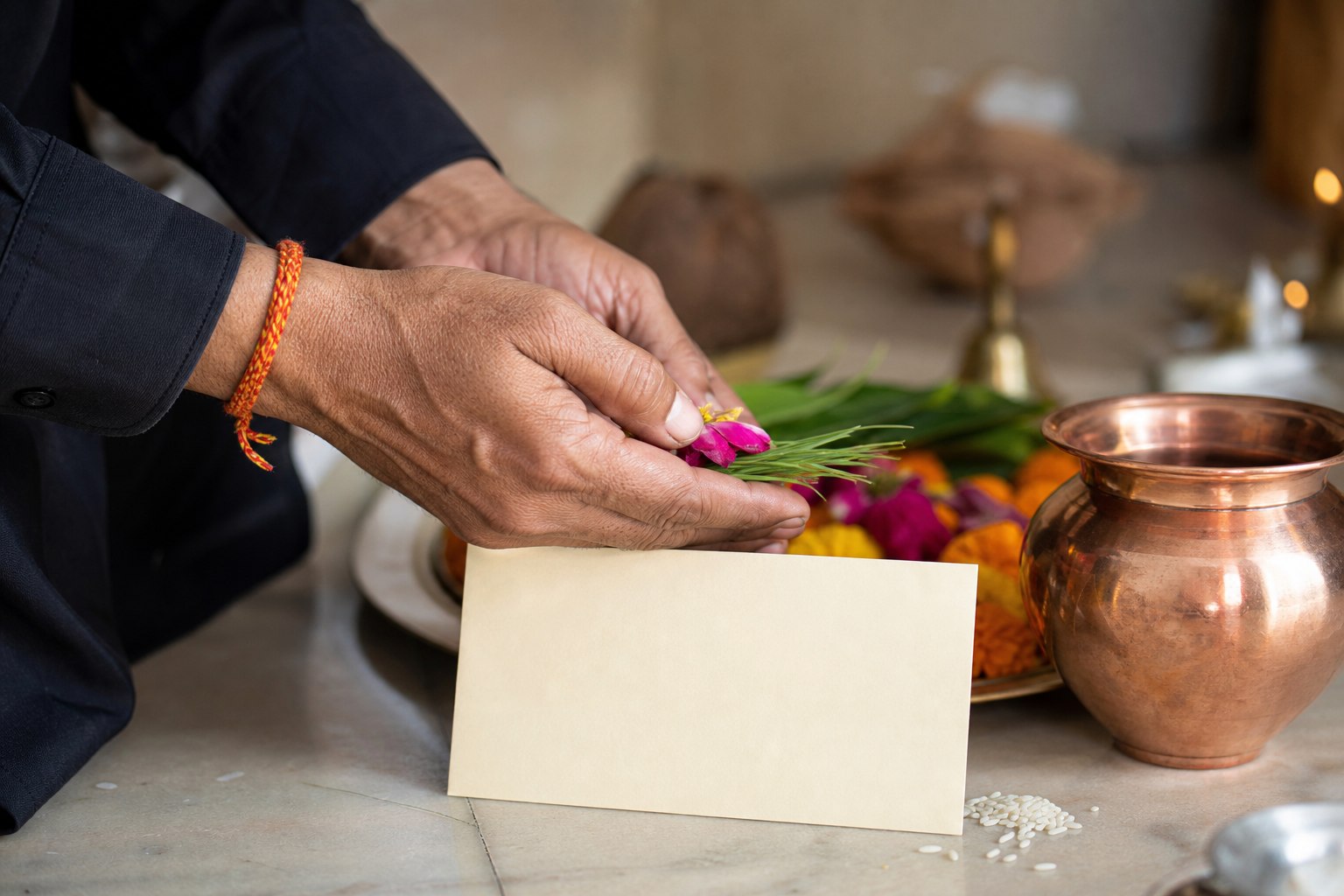
| Puja | The act of worship itself: the offerings, mantras and sequence performed before the murti. A puja is what happens inside a seva. |
| Ritvij | The one who performs a rite. The priest who knows the sequence, the mantras and the procedure. |
| Yajamana | The one on whose behalf a rite is performed, who commissions it and receives its fruit. Need not be present, but must be named. |
| Dakshina | The offering made to the one who performs a rite. Not a fee for goods; the classical sources treat a rite without dakshina as incomplete. |
| Sankalp | The statement of intention opening a rite, naming who it is for, where and on what occasion. The name and gotra are spoken here. |
| Gotra | Patrilineal lineage, traced from one of the ancient rishis. Spoken with the name in the sankalp. Kashyapa gotra is the accepted default for those who do not know theirs. |
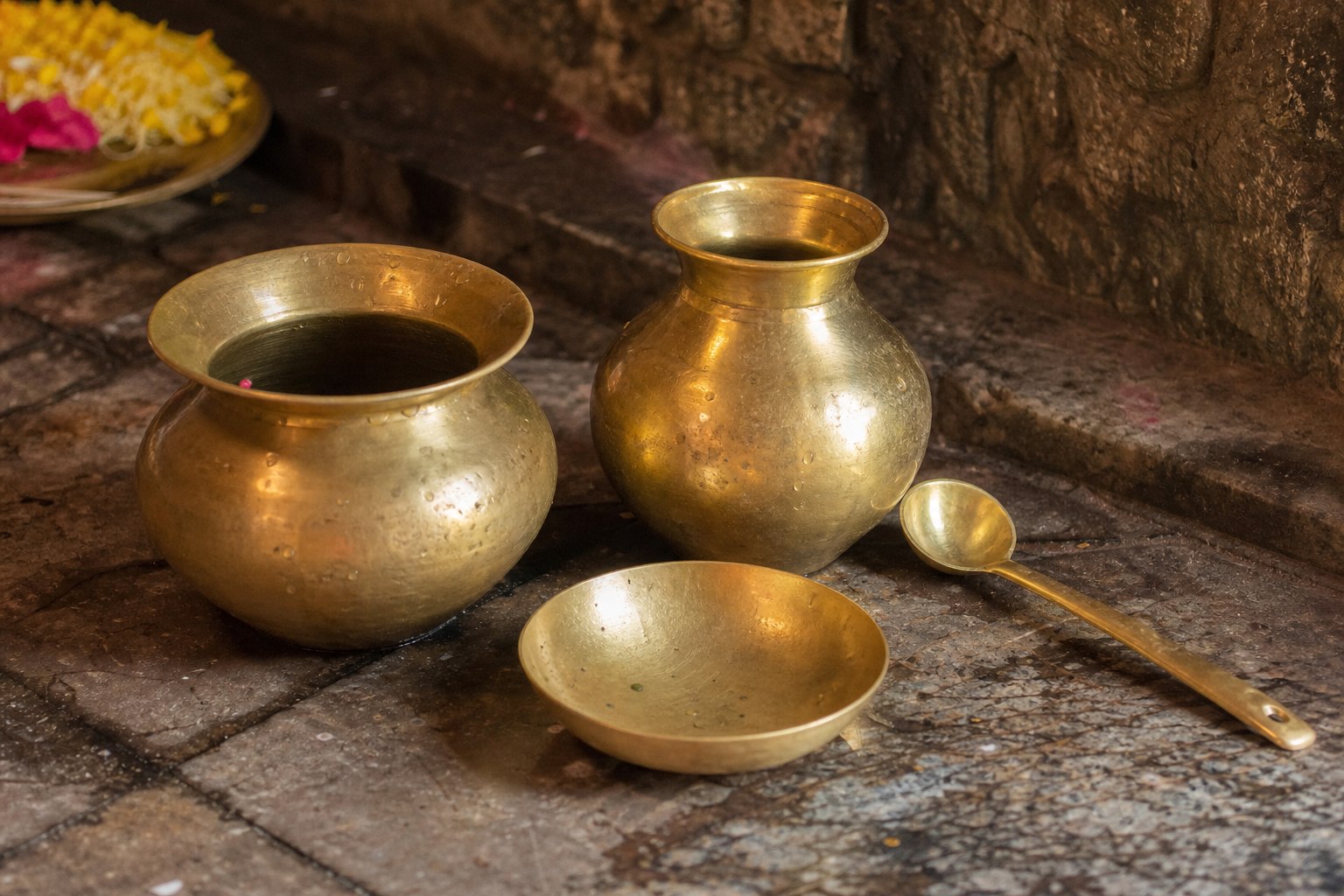
| Samagri | The materials used in a puja: the offerings, the lamp, the cloth, the grains. |
| Anushthana | A sustained observance kept over a period, such as a full japa count carried out across weeks. |
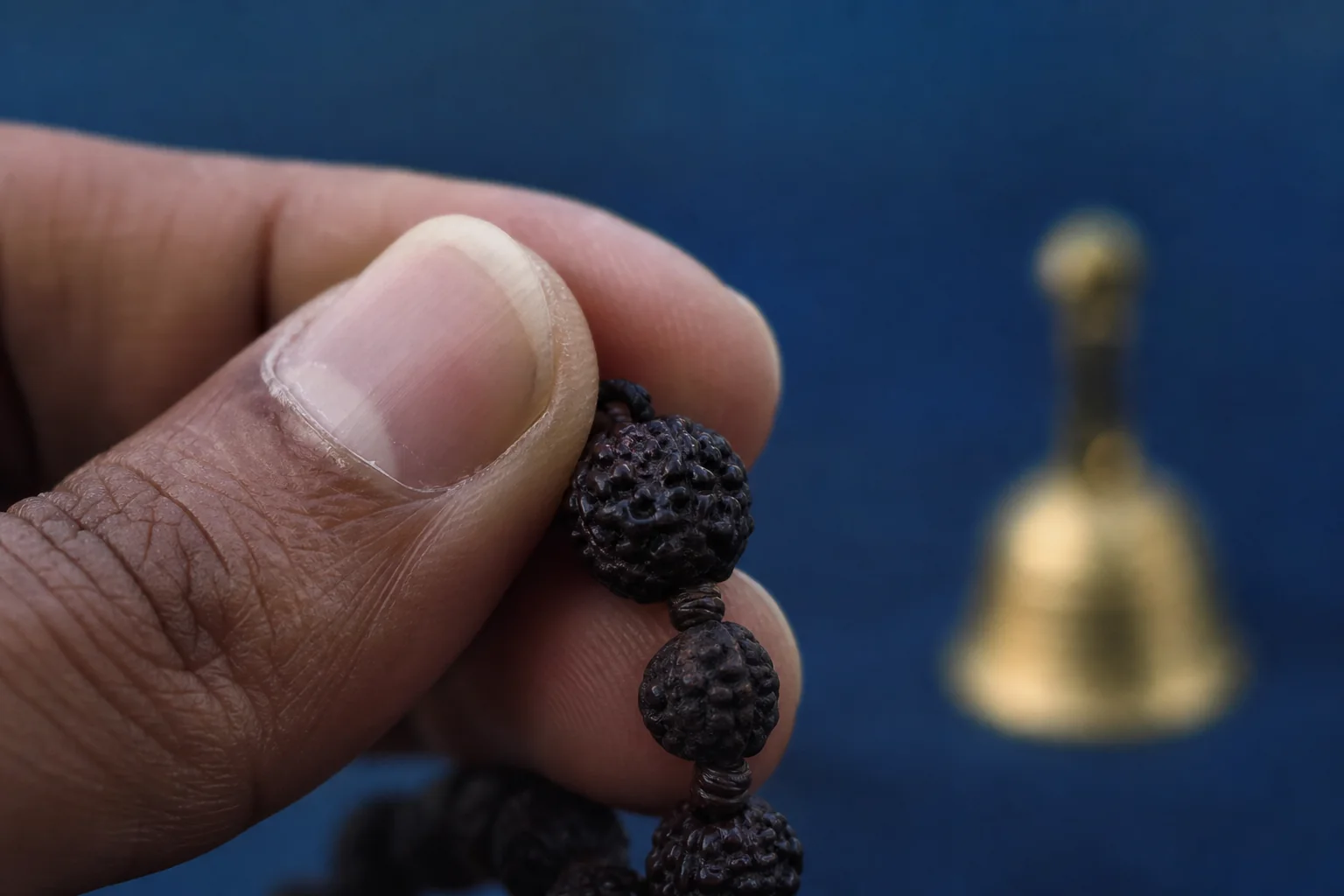
| Japa | Repetition of a mantra, usually counted on a mala of 108 beads. |
Seva meaning takes the ritvij and yajamana structure up in detail, including why paid ritual service is ancient rather than a modern innovation.
Astrological terms

| Term | Meaning |
|---|---|
| Graha | Usually rendered "planet", but closer to "one who seizes". Nine in the classical scheme, including the Sun, the Moon and the two lunar nodes. |
| Shani | The graha for Saturn. Also Shanaischara, "the slow-moving one", from Saturn's 29.46-year orbit. |
| Rashi | A sign of the zodiac. Janma rashi or chandra rashi is the sign the Moon occupied at birth, the reference point for most Vedic transit reckoning. |
| Gochar | Transit. The current movement of a graha through the signs, as distinct from its natal position. |
| Dasha | A planetary period. The sequence of dashas structures a Vedic life reading, and transits are read against it. |
| Ayanamsa | The offset between the tropical and sidereal zodiacs. The Lahiri ayanamsa is the standard followed in India and used throughout this site. |
| Panchang | The Hindu almanac, giving lunar dates, weekdays and auspicious timings. Must be computed for a location, since lunar moments do not respect calendar days. |
| Karmaphaladata | An epithet of Shani: the giver of the fruit of action. The doctrine that he delivers what has already been set in motion rather than inventing a fate. |
The Saturn transits, and their many names
| Term | Language | What it denotes |
|---|---|---|
| Sade Sati | Hindi, Marathi | Saturn in the 12th, 1st and 2nd from the natal Moon. 7.36 years on average. |
| Elinati Shani | Telugu | The same transit. |
| Ezharai Sani | Tamil | The same transit. |
| Moti panoti | Gujarati, Marathi | The same transit. "Large panoti". |
| Shani Dhaiya | Hindi | A different transit: the 4th or 8th from the natal Moon, about 2.5 years. |
| Nani panoti | Gujarati, Marathi | The same as Shani Dhaiya. "Small panoti". |
| Saturn return | English | A different reckoning entirely: Saturn back in its own birth sign, measured from natal Saturn. |
Elinati Shani, Ezharai Sani and Sade Sati maps these onto each other, and Saturn return and Sade Sati explains why the Western reckoning produces different dates.
Texts and observances
| Term | Meaning |
|---|---|
| Chalisa | A devotional poem of forty verses. The Shani Chalisa follows the form, with an opening and closing doha. |
| Doha | A two-line couplet, used to open and close a chalisa. |
| Chaupai | A four-line verse. The forty chaupais are the body of a chalisa. |
| Stotra | A hymn of praise, usually longer and more narrative than a mantra. The Dashrath Krit Shani Stotra is an example. |
| Kavach | Literally armour: a text recited for protection. The Shani Vajra Panjar Kavach is one. A kavach is recited, not bought as an object. |
| Aarti | The offering of light, and the song sung during it. The Shani Aarti is sung at the close of worship. |
| Beej mantra | A seed mantra, built from syllables carrying a deity's sound-form rather than sentence meaning. See Shani beej mantra. |
| Shanivar | Saturday, the day belonging to Shani in the Vedic weekday scheme. |
| Amavasya | The new moon, ending the dark fortnight. An astronomical instant, not a calendar day. |
| Shani Jayanti | The birth anniversary of Shani Dev, on the Amavasya of the month of Jyeshtha. |
| Tarpan | Water offered in remembrance of the ancestors, customarily on Amavasya. |
| Mala | A string of 108 beads plus a marker bead, used to count japa. |
Two distinctions worth getting right
Sade Sati is not Shani Dhaiya. Sade Sati covers three signs around the natal Moon and runs about 7.36 years. Shani Dhaiya covers one sign, the fourth or eighth, and runs about two and a half. They occur at different points in the cycle and treating one as another name for the other produces wrong dates.
Rashi is not a sun sign. The janma rashi is where the Moon stood at birth. A Western sun sign is where the Sun stood. The two systems also use different zodiacs, separated by the ayanamsa, so the answers differ on two counts. A calculator computing Sade Sati from a sun sign is answering a different question from the one the tradition asks. Our Sade Sati calculator works from the Moon, and how we compute sets out the ephemeris and ayanamsa behind it.
Where these words appear
If you have arrived here from a term in another post, these are the pages the vocabulary comes from: what is a Saturn return for the story of Shani himself, observing Shani without a temple for practice at a distance, and what the Chalisa actually says for the text.
For the tools, the Saturn return calculator and the Sade Sati calculator, with every Sade Sati period from 1950 to 2050 published in full. For the observances themselves, every seva is listed with what it involves and how it works sets out each step.
Conclusion
Most of the vocabulary above resolves into a small number of ideas: that a rite has someone who performs it and someone it is for, that transits are measured from the Moon, and that Shani delivers what has already been set in motion rather than deciding it.
If a term appears elsewhere on this site and is not defined here, tell us. This page is meant to be the one that stops a reader having to guess.