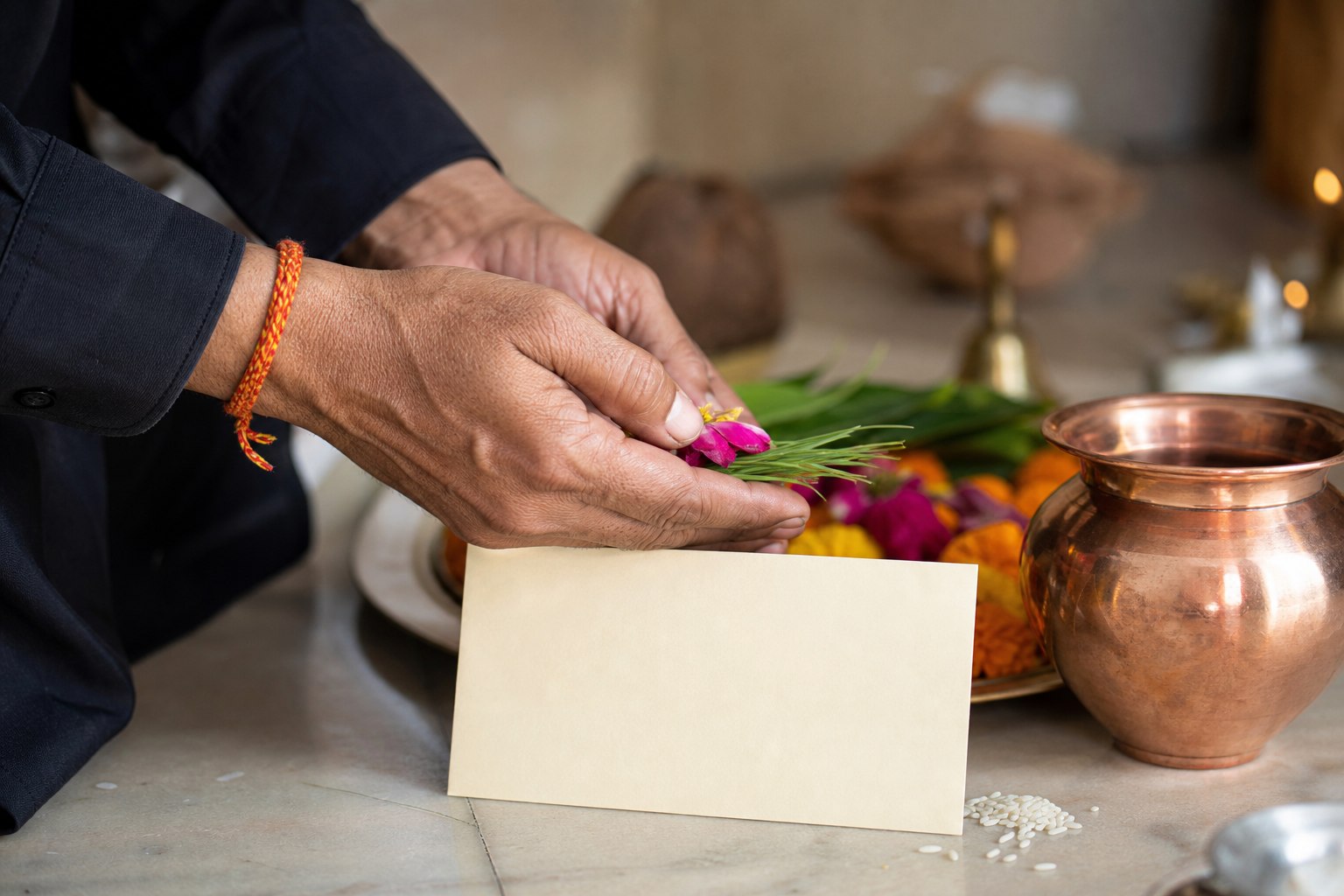
The Shani beej mantra is Om Praam Preem Praum Sah Shanaischaraya Namah. It is the seed mantra of Shani Dev, and unlike a stotra or a chalisa it is not a sentence. The middle syllables, praam, preem, praum and sah, are bija: seed sounds that carry the sound-form of the graha rather than dictionary meanings. Only the opening and closing translate as ordinary language. Shanaischaraya means "to Shanaischara", the slow-moving one, and namah means "salutation". The traditional count for a complete observance is 23,000 repetitions, kept over weeks rather than in one sitting.
What a seed actually is
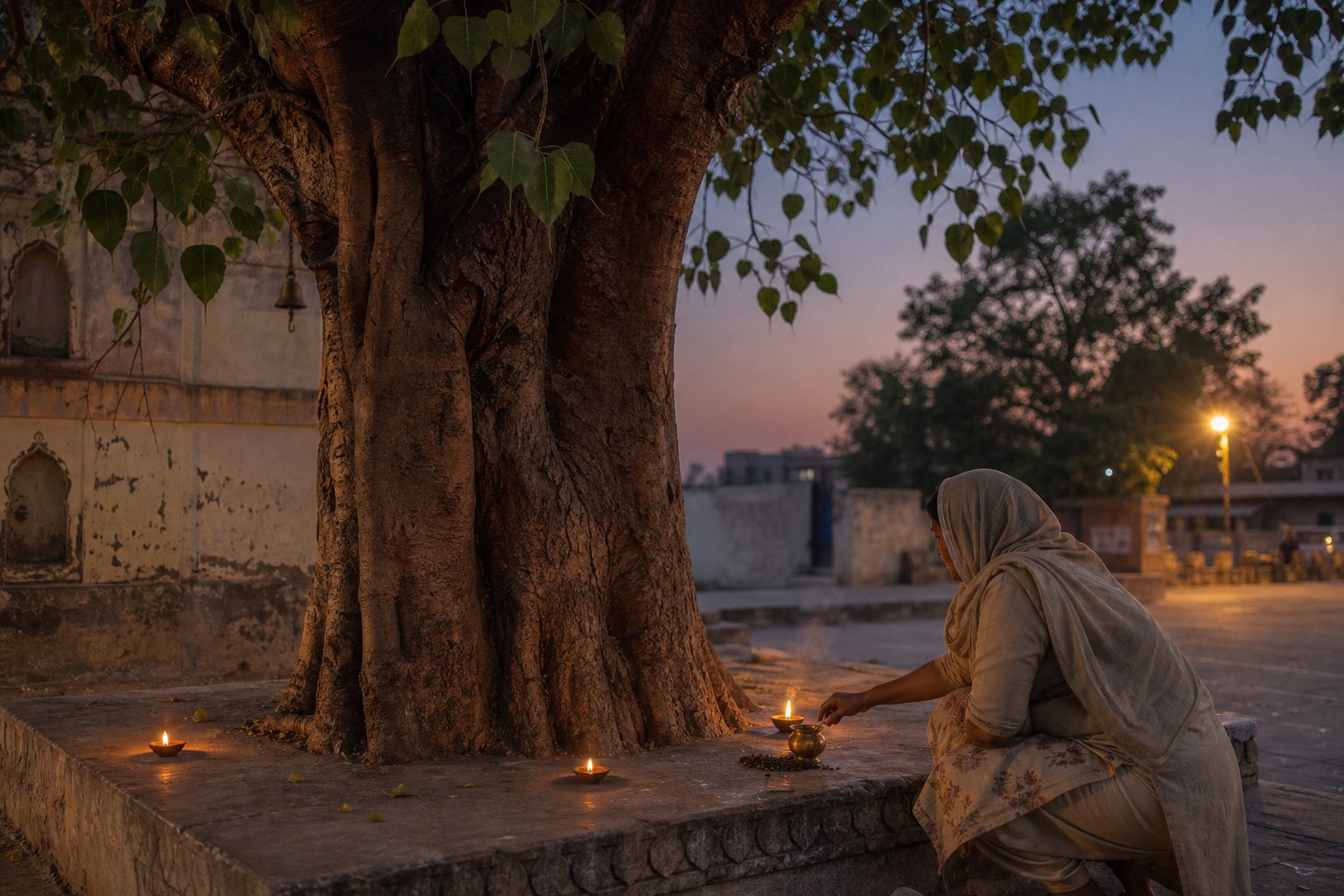
Hold a peepal seed in your palm and look at it.
It is nothing. Smaller than a grain of rice, brown, dry, entirely unremarkable. You could lose it in the creases of your hand and not notice.
Inside that nothing is a tree that will outlive your grandchildren. Bark you cannot get your arms around. Roots that will lift a stone wall without hurrying. Shade for a whole courtyard, and after you are dead, shade for people who never knew your name.
None of that is written on the seed. There is no picture of the tree inside it, no instructions, nothing you could read even with the finest lens. The tree is simply present in the seed in a form that has no resemblance to a tree.
That is what bija means, and it is why the middle of this mantra does not translate.
Praam. Preem. Praum.
You can look for those in a Sanskrit dictionary and you will not find them, because they are not abbreviations of longer words and they are not describing anything. They are the same relationship to Shani that the seed has to the tree. Not a picture of him. Him, in a form that has no resemblance.
Which explains something people find strange when they first meet mantras. The Chalisa is forty verses and takes ten minutes. This is seven syllables and takes four seconds.
They are not different lengths of the same thing.
One is the courtyard tree, described.
The other is what you hold in your palm and put into the ground.
What a beej mantra is
Beej means seed. A beej mantra is built from syllables held to contain the essential sound-form of a deity or force, compressed rather than described.
Longer texts work differently. The Shani Chalisa is forty verses of praise and petition with plain semantic content, and the Dashrath Krit Shani Stotra is a hymn with narrative and argument, spoken by a king who flew to the edge of the sky to say it. A beej mantra is the compressed form, and the three are used for different purposes rather than being alternatives.
For a survey of every mantra used in a full Shani puja and where each fits, Shani puja mantra, explained covers that ground, and the Shani mantras page carries the texts with transliteration.
The mantra, part by part
| Part | Devanagari | What it carries |
|---|---|---|
| Om | ॐ | The opening syllable of nearly all mantras |
| Praam | प्रां | Seed syllable, Shani's sound-form |
| Preem | प्रीं | Seed syllable |
| Praum | प्रौं | Seed syllable |
| Sah | सः | Bija associated with the graha |
| Shanaischaraya | शनैश्चराय | "To Shanaischara", the slow-moving one |
| Namah | नमः | "Salutation" |
Shanaischara is worth pausing on. It is built from shanaih, meaning slowly, and chara, meaning one who moves. The slow-moving one. A plain description of the planet: Saturn takes 29.46 years to complete an orbit, and it is the slowest of the classical grahas visible without a telescope.
The name is not metaphor. It is observation, and the whole character the tradition gives Shani follows from a planet that takes thirty years to come back. How long a Saturn return lasts takes up what that slowness means in practice.
Where the count of 23,000 comes from
Each graha has a traditional japa count for a complete anushthana, a sustained observance. Shani's is 23,000.
The counts are not arbitrary and not uniform. The Sun's is 7,000, the Moon's 11,000, Mars's 10,000. Shani's is the largest among the classical grahas, and the tradition connects that to the slowness of the planet itself. What is slow to move is slow to be approached.
In practice 23,000 is kept over weeks. A mala is 108 beads, so a full anushthana is roughly 213 malas: a sustained daily practice across a month or more, not something completed in an evening. Most people reciting regularly do one mala, 108 repetitions, on Saturdays.
| Observance | Count | Typical duration |
|---|---|---|
| One mala | 108 | A single sitting |
| Weekly practice | 108 on Saturdays | Ongoing |
| Full anushthana | 23,000 | Weeks to months |
How a mala is used
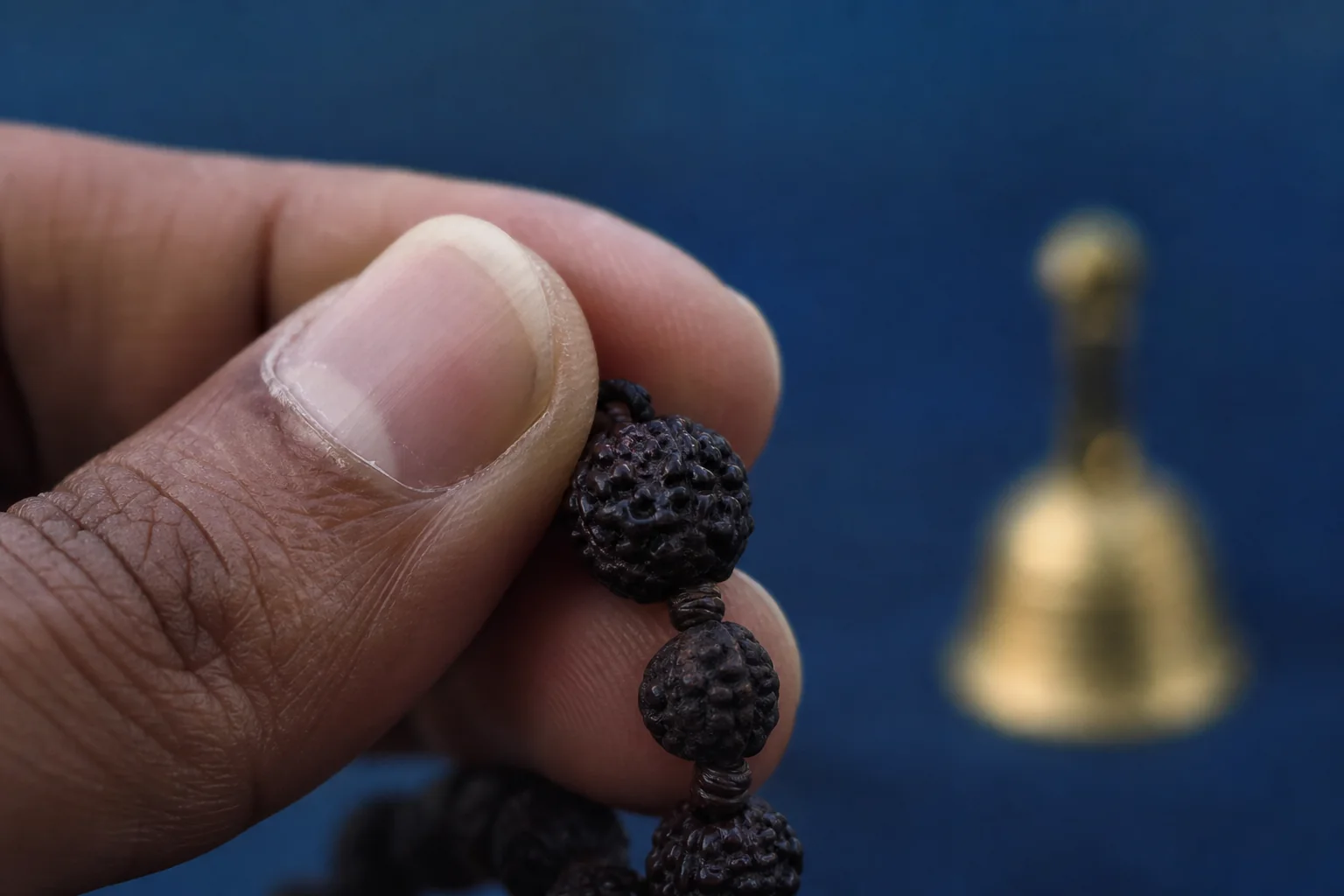
A japa mala has 108 beads and one larger bead, the meru or sumeru, which marks the start. The mantra is recited once per bead, moving from the meru around the loop.
On reaching the meru again the count is one complete mala. Customary practice is not to cross the meru but to reverse direction and go back the other way, so the marker bead is never counted or passed over.
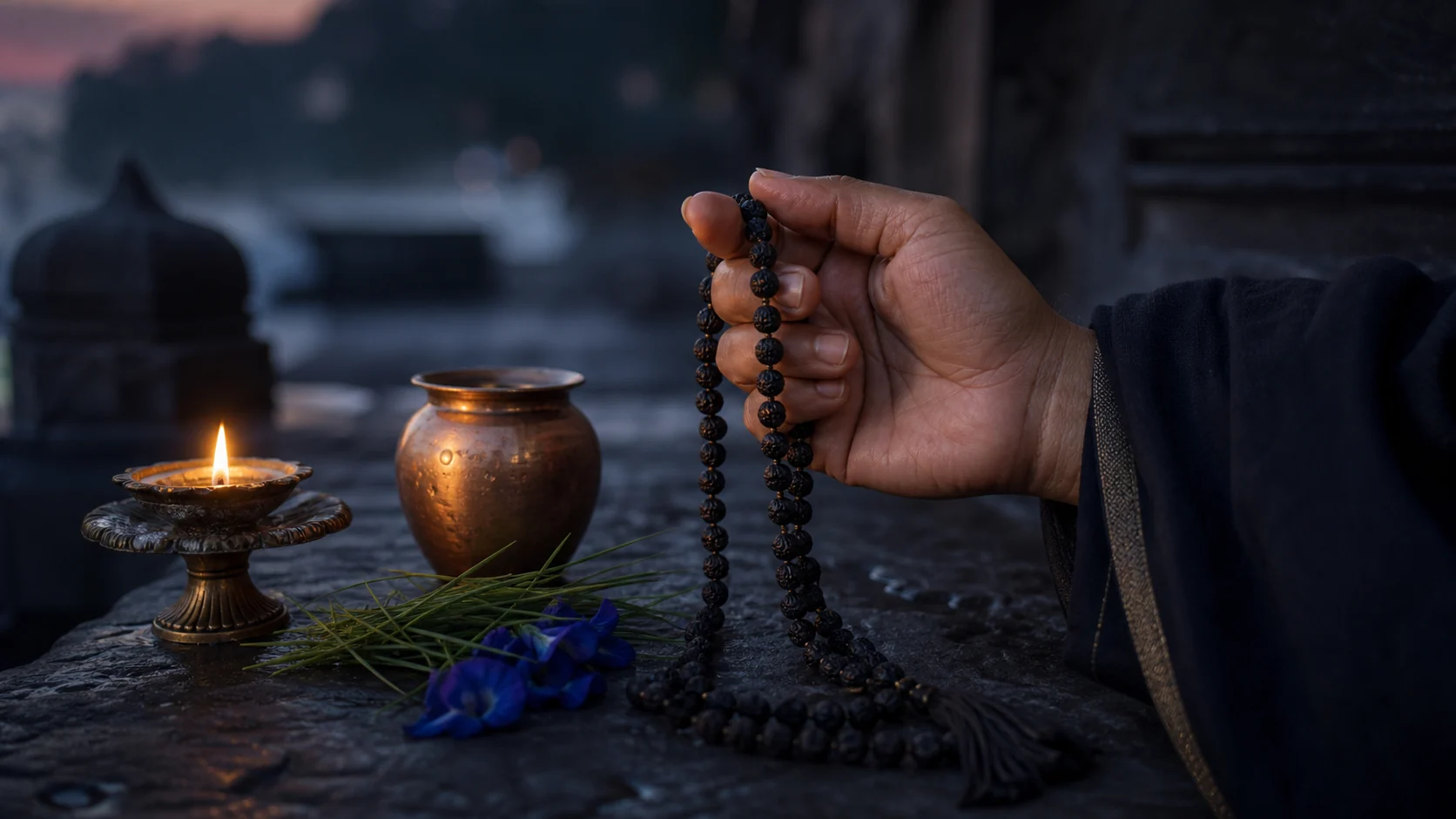
For Shani the customary mala is black, often of iron wood, black agate or rudraksha. This is convention rather than requirement, and the sources are considerably less exercised about mala material than the market that sells malas. Our Shani mantra page keeps a count in the browser for anyone without a mala to hand, stored locally and never sent anywhere.
Pronunciation, and how much it matters
The most common anxiety among people who did not grow up with Sanskrit, and it deserves a direct answer.
The tradition places weight on intention and consistency. There is no threshold of phonetic accuracy below which a recitation is held to fail, and the sources do not describe one. Reciting with attention, in whatever approximation you can manage, is accepted practice.
The nasalised endings, the -aam, -eem, -aum sounds, are the part most often lost by English speakers and are worth attempting because they carry the shape of the sound. But an imperfect attempt made regularly is treated as better practice than a perfect one made anxiously, and considerably better than not attempting at all. Observing Shani without a temple takes up the wider question of practice at a distance.
When it is recited
Saturday, customarily, since Saturday is Shanivar and belongs to Shani in the Vedic scheme of weekdays. Evening, after lighting a lamp, is common practice.
Neither is a scriptural requirement. The classical sources are far less prescriptive about hours and directions than most online guidance implies. Consistency across weeks is what the tradition emphasises, which suits a graha whose entire character is the long view.
What the mantra does not do
It does not cancel a transit. The Sade Sati calculator will show that the dates come from Saturn's position, and no count of repetitions moves them. Every period from 1950 to 2050 is published so you can check.
Shani is Karmaphaladata, the giver of the fruit of action. If consequence follows what has been done, then recitation cannot settle an account, and any claim that a specific number of repetitions produces a specific outcome is not from these sources. What the tradition holds is narrower: that remembrance steadies the person doing the remembering. Honest answers sets out why we hold that line.
If you would like it recited on your behalf
A full anushthana of 23,000 is a serious undertaking, and for many people, working, caring for family, living far from a temple, it is not realistic to keep alone.
Shani Mantra Jaap is that recitation performed at our centre in India with your name and gotra spoken in the sankalp. Sankalp and Gotra Recitation is the naming itself. Every seva is listed with what it involves, and how it works sets out each step.
It does not replace your own practice and does not purchase an outcome. It is the observance kept on your behalf when you cannot keep it yourself.
Conclusion
Om Praam Preem Praum Sah Shanaischaraya Namah is a salutation to the slow-moving one, built around seed syllables rather than sentences. The traditional count is 23,000 across a sustained observance; the daily practice is 108, one mala, customarily on Saturdays.
The text with Devanagari and transliteration is on the Shani mantras page, along with the Gayatri and pranam mantras. For what the Chalisa asks for and what it does not promise, Shani Chalisa benefits takes it up.