Seva means service. In modern everyday usage, particularly in the diaspora, it usually means unpaid voluntary work: serving food at a gurdwara, cleaning a temple, giving time. In ritual practice it means something narrower and older, a defined observance performed at a temple or shrine, often on behalf of a named person who is not present. Temples have listed and priced these for centuries. Tirupati, Shirdi and Siddhivinayak all publish seva lists with fixed amounts and online booking, and the structure that makes this coherent has a name in the classical sources.
A name spoken in a room you have never seen

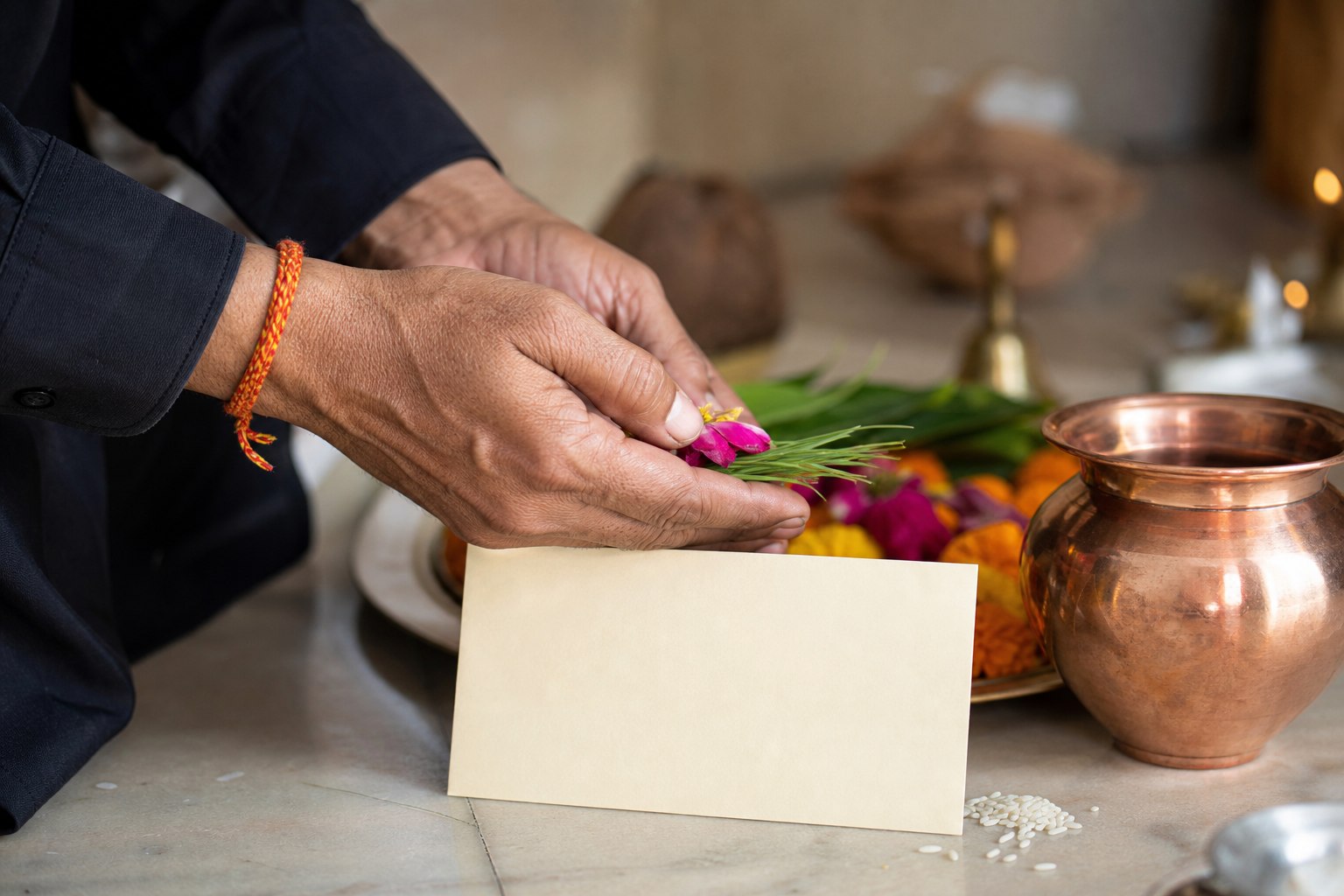
It is early. The lamp is lit and the floor is cold and the pandit sits down and takes water in his right hand.
Then he begins to place you.
He says the day. Not the date on a phone, but the tithi, the paksha, the month by its old name. He says where he is sitting, the region, the river nearest to it. He is building an address, and it is not his own.
Then he says your gotra. The rishi your father's father's line came down from, a man who lived so long ago that nobody in your family has ever been able to picture his face, and whose name you may have had to telephone an uncle to learn.
Then he says your name.
And in a room you have never stood in, six thousand miles from wherever you are reading this, in a language you may not speak, you are now present.
That is the sankalp, and it is the entire mechanism.
The tradition never asked you to be in the room. Look at how a Vedic rite is actually built and you find two people in it, not one. There is the ritvij, who performs, who knows the sequence and the mantras and does the work. And there is the yajamana, on whose behalf it is done, who receives what it yields.
These were always different people. Not because someone was too busy to attend. Because that is the shape of the thing.
Dasharatha did not chant for himself. Kings did not. Householders did not. Someone who had spent their life learning the sequence performed it, and the one it was for was named aloud so the rite would know where to go.
Your grandmother in Coventry has not been left out of something. She is standing exactly where the yajamana has always stood.
She simply has an ocean in the way, and the sankalp has never once been troubled by distance.
The two senses of the word
| Everyday sense | Ritual sense | |
|---|---|---|
| What it names | Voluntary service given freely | A defined, named observance |
| Typical example | Serving langar, temple cleaning | Abhishekam, archana, a named puja |
| Performed by | The devotee | A ritvij, on the devotee's behalf |
| Payment | None | Dakshina; temples publish rates |
Both are real. Neither is a corruption of the other. What has happened in the last century is that the first sense travelled widely, through Sikh practice and through NGO and volunteering vocabulary, while the second stayed inside temple usage. So a reader who meets "paid seva" often assumes a category error is being committed.
Ritvij and yajamana

The ritvij is the one who performs the rite: the priest who knows the sequence, the mantras and the procedure. The yajamana is the one on whose behalf it is performed, who commissions it and who receives its fruit. These are different people, and the distinction is fundamental to Vedic ritual rather than a later convenience.
The yajamana need not perform anything. What the yajamana does is intend, commission, and offer dakshina, the offering made to the one who performs. The classical sources are direct that a rite without dakshina is incomplete. It is not an optional gratuity but part of the structure of the rite itself.
This is why paid ritual service is ancient and unremarkable in Hindu practice. It is not a modern commercialisation of something that used to be free. It is the arrangement the tradition describes.
The sankalp, and why the name is spoken
Every rite opens with a sankalp: a statement of intention naming who the rite is for, where it is being performed, and on what occasion.
The yajamana's name and gotra are spoken in it. Gotra is the patrilineal lineage, tracing descent from one of the ancient rishis, and it identifies a person within a line rather than only as an individual. Those who do not know theirs may use Kashyapa gotra, which is the accepted default. The Shani glossary defines each of these terms.
The sankalp is what makes a rite performed by one person on behalf of another coherent rather than a substitution. The ritvij is not pretending to be the yajamana. The ritvij is performing, by name and by lineage, for someone identified aloud at the outset. Sankalp and Gotra Recitation is that naming, performed at our centre.
Where temples publish their rates
This is checkable, and worth checking if the idea of paid seva sits uneasily.
Tirumala Tirupati Devasthanams publishes an extensive seva list, arjita sevas with named rates and an online booking system. The Shri Saibaba Sansthan Trust at Shirdi does the same. Siddhivinayak in Mumbai does the same. These are among the largest and most orthodox temple institutions in India, and none treats a published rate as a compromise of the practice.
What each is doing is what temples have always done: naming the observances available, stating what each involves, and allowing a devotee to commission one.
Seva and puja are not synonyms
Puja is the act of worship: the offerings, the mantras, the sequence performed before the murti. Seva is the wider category of service, and a puja performed on a devotee's behalf is one kind of seva.
In temple usage the distinction is practical. A seva is a listed item: this observance, at this time, with these offerings. The puja is what happens inside it. Our own seva list follows the same convention, and how it works sets out each step of one.
What Shani seva means specifically
Shani is Karmaphaladata, the giver of the fruit of action. That doctrine shapes what a Shani seva can honestly claim to be, and it rules a great deal out.
If Shani delivers the fruit of what has already been done, then no observance settles an account. A seva does not cancel a transit, and the Sade Sati calculator will show you that the dates come from Saturn's position rather than from anything a devotee arranges. Every period from 1950 to 2050 is published so you can check. Anyone offering to remove a Sade Sati for a fee is not describing this tradition.
What a Shani seva is, honestly stated: the observance kept on your behalf, by name and gotra, when you cannot keep it yourself. That is narrower than the market generally claims and it is what the structure actually supports. Honest answers sets out the strongest objection to remote seva, including the position of the Shani Shingnapur temple.
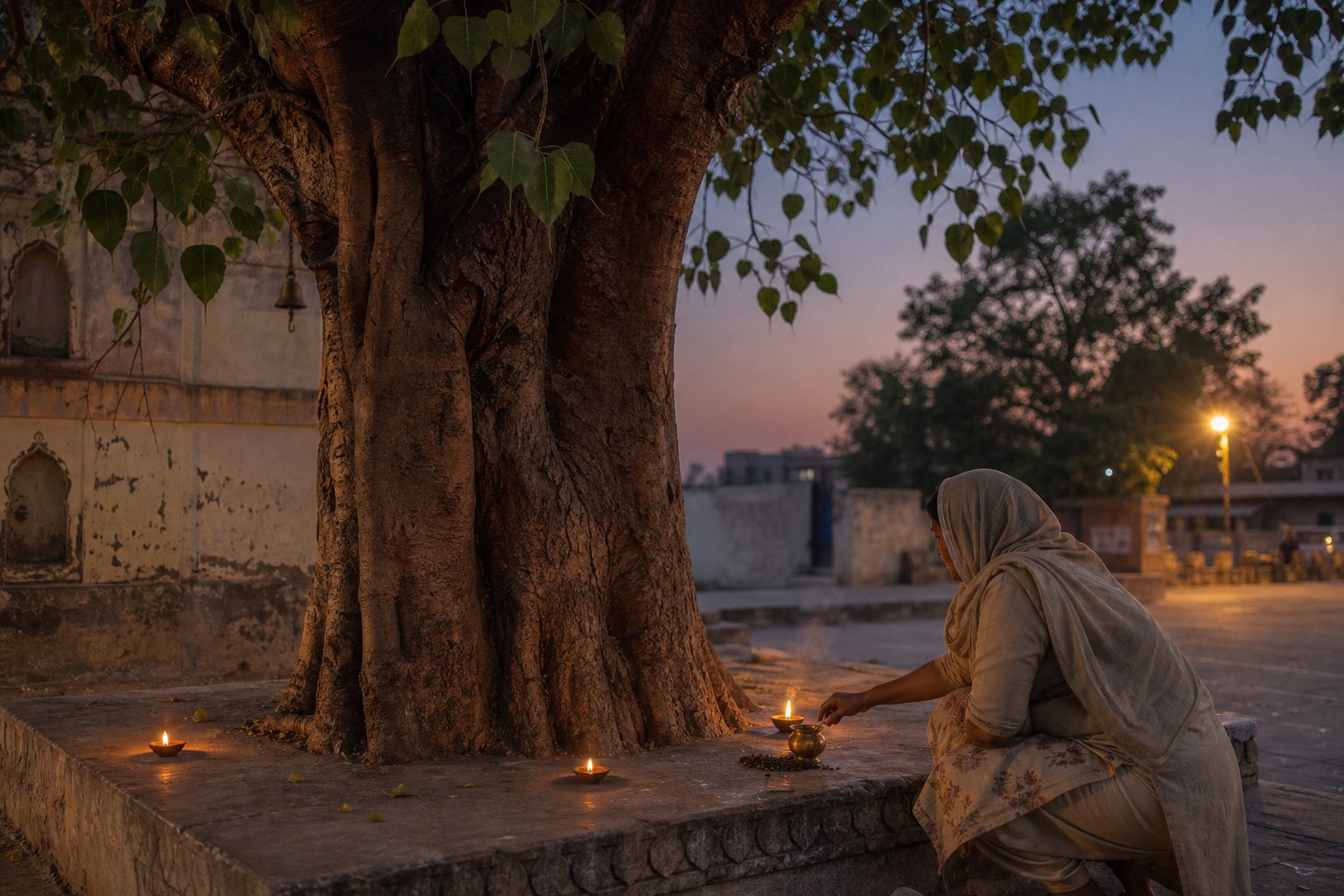
The remedies the Shani texts return to are conduct rather than commission: honest work, patience, care for the elderly, the poor and those who labour. The Shani Chalisa prescribes two, water at the peepal on his day and the giving of a lamp, and what the Chalisa actually says takes that up. No seva substitutes for those. Til Tel Abhishek, Deepdaan and Anna Seva are what those remedies look like when kept on your behalf.
Why proxy seva matters to people abroad
The ritvij and yajamana structure is why a devotee in Birmingham or Toronto can commission a rite performed in India without that being a workaround.
The tradition never required the yajamana to be present. It required the yajamana to be named. Distance is a practical fact rather than a doctrinal obstacle, and families have commissioned rites at temples they could not reach for as long as there have been temples and distances.
What changes abroad is which observances are available at all. There is no peepal tree in most of Britain and no Shani temple within reach of most Canadian cities. Observing Shani without a temple takes that question up in full.
Conclusion
Seva means service, and in ritual practice it names a defined observance performed on a devotee's behalf. It has been paid for throughout Hindu history through dakshina, and the ritvij and yajamana structure is what makes performance on behalf of another coherent.
What it cannot do is buy an outcome. That is not a limitation we imposed for modesty. It follows directly from the doctrine that Shani gives the fruit of action.