The Shani Chalisa is a devotional text of forty chaupais with an opening and closing doha, addressed to Shani Dev. What it asks for is protection, relief from difficulty and the removal of fear. What it does not do, and this is where most published benefit lists part company with the text, is promise wealth, guarantee an outcome, or offer to cancel a planetary transit. The two remedies it prescribes are water offered at the peepal tree on Saturday and the giving of a lamp.
The king who argued with him
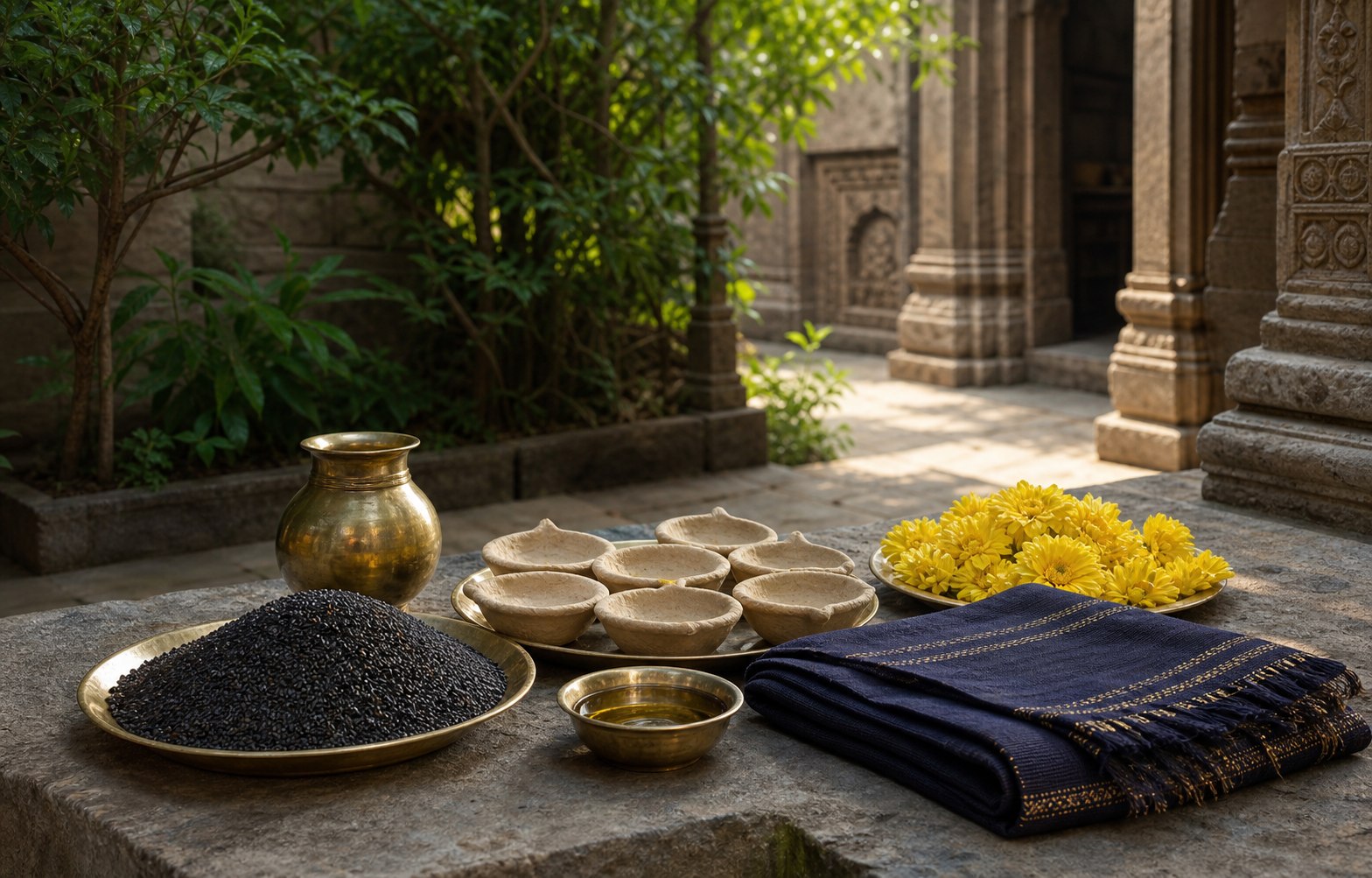
There is one story where somebody stands in front of Shani and does not run.
Dasharatha was told by his astrologers that Shani was about to enter a particular position, and that when he did, the rains would fail for twelve years. Not the king's rains. Everyone's. Twelve years of dust across the whole of Kosala, cattle dying in the fields, children born into famine.
Any other king would have ordered a sacrifice and hoped.
Dasharatha got into his chariot and drove it up into the sky, and he went out past the sun and past the moon and out to where the slow one moves, and he arrived in front of Shani with his bow already drawn.
What happened next is the part people forget.
He did not shoot.
He stood in his chariot with a divine weapon in his hands, close enough to use it, and instead of using it he began to praise. He named Shani. He named him truly, not flattering, not begging. He said what the god actually was: the one who is feared by everyone including the gods, the one who cannot be turned aside, the one whose gaze even Indra will not meet.
He told the truth about him to his face, having come armed and having chosen not to fight.
And Shani, who has been turned away from since the hour he was born, who has been flattered by frightened men for ten thousand years and never once been simply seen, said: ask.
Dasharatha asked that the twelve-year drought be lifted from the world.
Not from his kingdom. From the world. He had flown to the far edge of the sky and drawn a bow on the god of consequence, and what he asked for was rain for people who would never know his name.
That is the hymn. The Dashrath Krit Shani Stotra is what a king said with a weapon in his hand and no intention of using it.
And it is the shape of every Shani text that came after it, including the Chalisa. Not: let me off.
Something closer to: I see who you are, and I am not asking for myself alone.
What the text actually contains
The Chalisa form is a forty-verse devotional poem, the best known example being the Hanuman Chalisa. The Shani Chalisa follows the same structure: an opening doha, forty chaupais, and a closing doha.
Its content divides into three movements. The first establishes who Shani is, son of Surya and Chhaya, the graha of consequence, dark of aspect and slow of movement. The second recounts episodes from the traditional literature in which Shani's gaze fell on gods and kings, establishing that no one is exempt. The third is petition: a request for protection, for the lifting of difficulty, and for the removal of fear.
That third movement is where a reader looking for benefits will find them, and it is worth being precise about what is asked. The petitions are for protection and relief. They are not requests for a particular result, and the text does not offer an exchange. The full text with transliteration and verse-by-verse English meaning is at Shani Chalisa.
What the tradition holds about reciting it
Shani is Karmaphaladata, the giver of the fruit of action. That single doctrine governs everything else, and it is what makes the popular framing of Chalisa recitation as a transaction incoherent on the tradition's own terms.
If Shani delivers the fruit of what has already been done, then no recitation cancels what is owed. A text read forty times does not settle an account. What the tradition holds instead is that remembrance steadies the person doing the remembering: that turning toward Shani during a demanding period changes how it is met, not whether it arrives.
That is a real claim and a modest one. It is also the only claim the sources actually make, and honest answers sets out why we hold that line.
When it is recited
| Question | Common practice | What the text requires |
|---|---|---|
| Which day | Saturday, Shanivar | Not specified in the Chalisa itself |
| What time | Evening, after lighting a lamp | Not specified |
| How many times | Once; more during Sade Sati | No count given |
| Which language | Devanagari, or a translation | Not specified |
| Where | Home or temple | No place required |
The right-hand column is short for a reason. Much of what circulates as rule, recite at this hour, this many times, facing this direction, is later accretion rather than scripture. Some of it is sound custom. None of it is a condition the text imposes.
Saturday, and why
Saturday is Shanivar in the Vedic scheme of weekdays, where each day belongs to a graha. That is the basis for keeping Shani observances then, and it is consistent across the tradition and across regions.
It is also the practical reason the Chalisa is generally recited weekly rather than daily. Shani is the slow planet, the graha of the long view, and a weekly rhythm suits that better than a daily one. What to offer Shani Dev on Saturday covers the wider Saturday practice.
Reciting it in a language you understand
A recurring anxiety, particularly for readers who grew up outside India: whether reciting in English, or with imperfect pronunciation, counts.
The tradition places weight on intention. Reading a translation, reading the transliteration, or reading the Devanagari haltingly are all accepted practice, and the sources do not describe a threshold of fluency below which the recitation fails. Our Shani Chalisa page publishes the Devanagari, a faithful transliteration and a plain English meaning for every verse.
One caution worth stating: some widely circulated English renderings of individual verses reverse the sense of the original, usually by turning a petition for protection into a promise of reward. Where that occurs on our text page, it is flagged. Observing Shani without a temple takes up the wider question of practice at a distance.
The two remedies
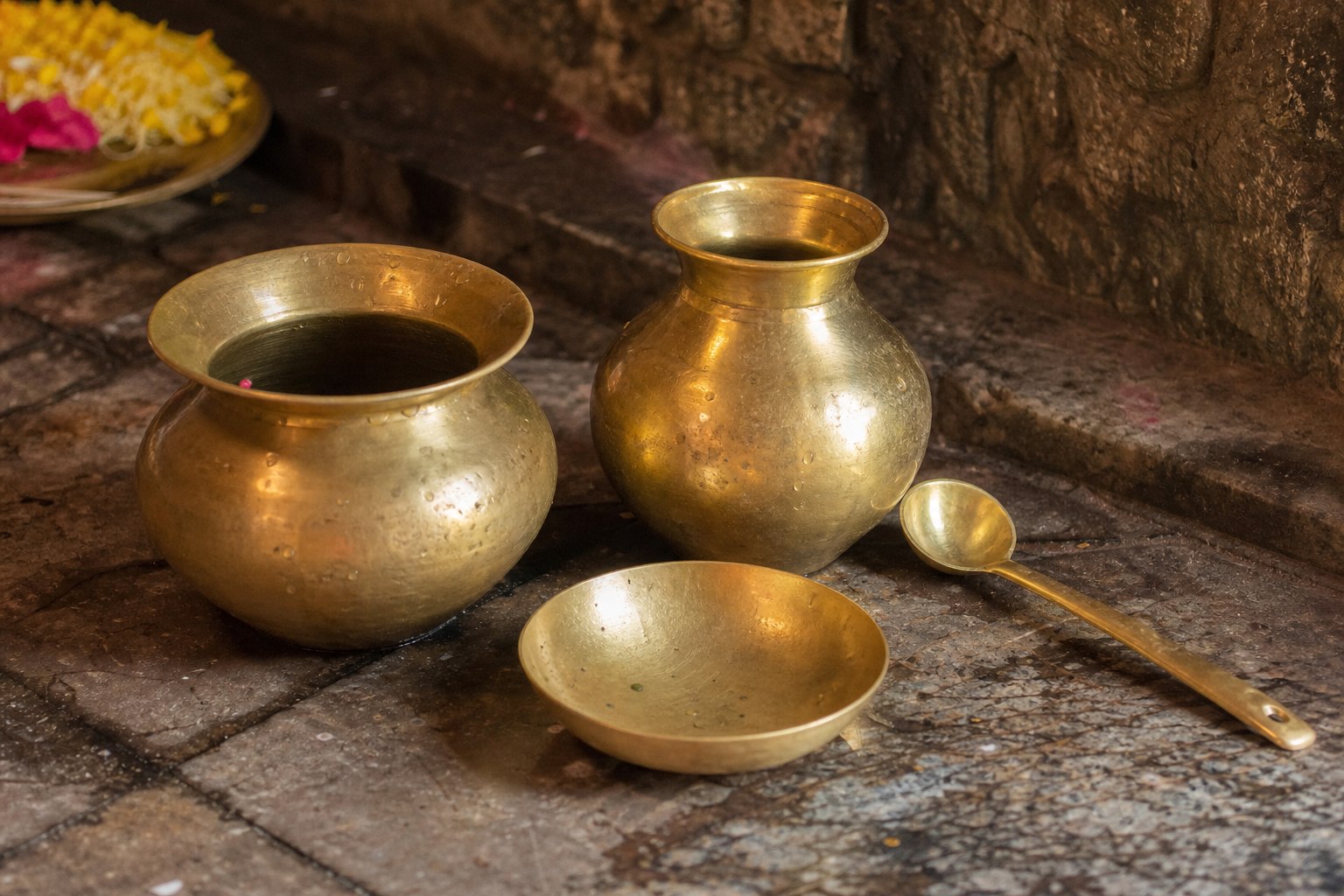
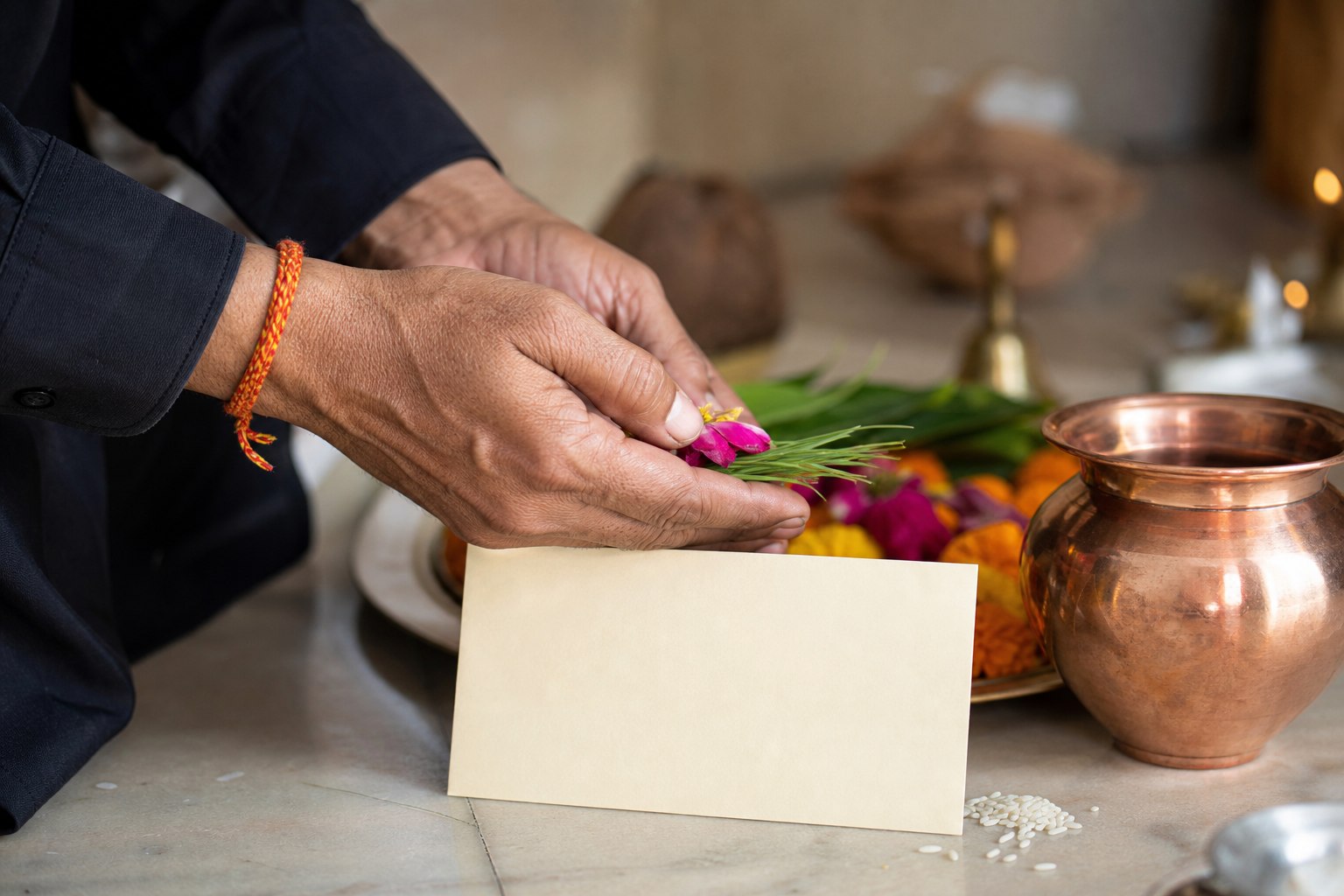
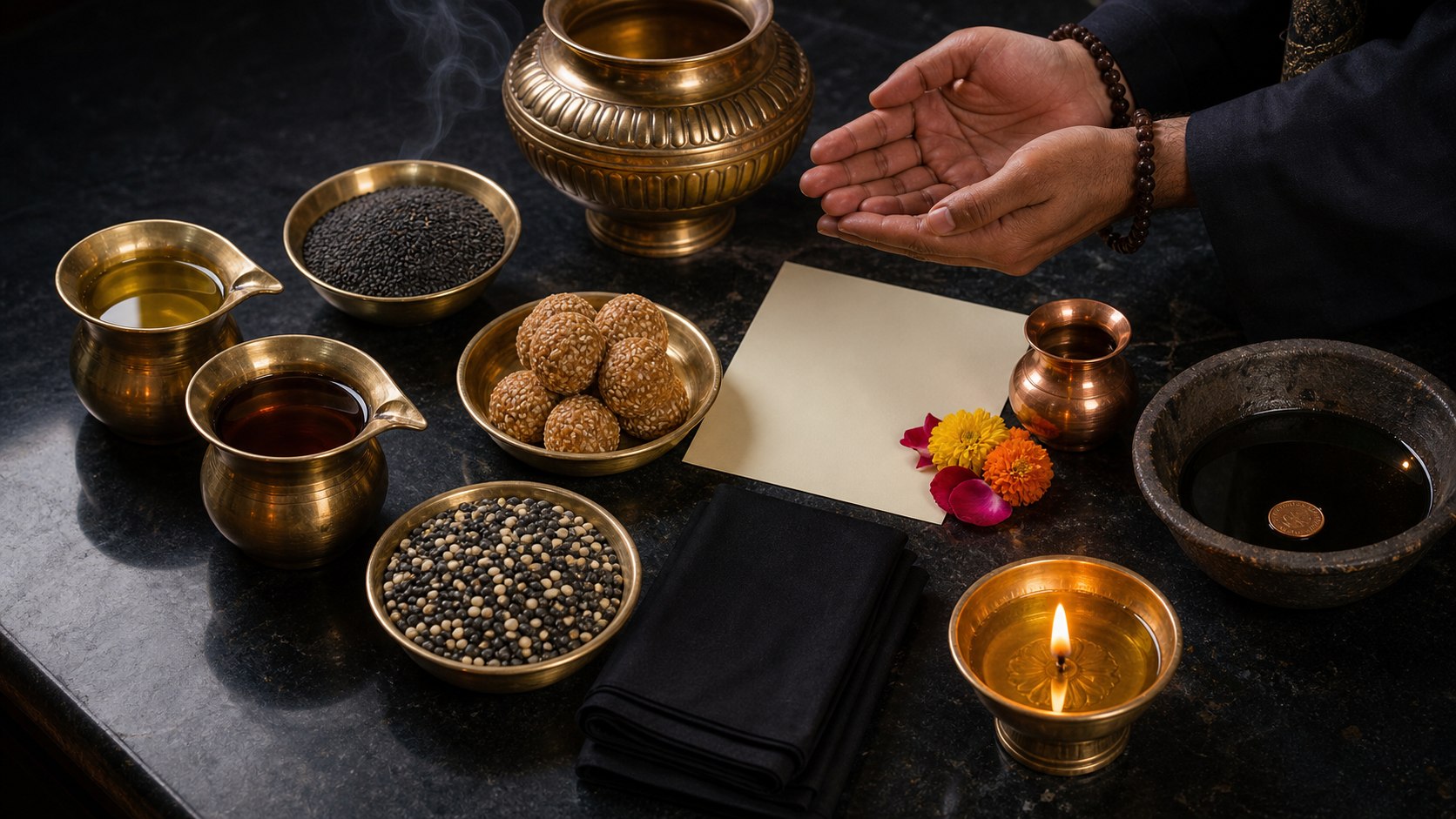
The Chalisa prescribes water offered at the peepal tree on Shani's day, and the giving of a lamp. Nothing else.
For a deity with Shani's reputation that is a remarkably short list, and the shortness is doctrinally consistent. If consequence follows action, then remedies cannot be elaborate purchases. They can only be small acts of attention and giving. The wider Shani literature reinforces this, returning repeatedly to care for the elderly, the poor and those who labour rather than to ritual complexity.
The peepal is the one item unavailable to most readers outside India. Where a temple or a tree is out of reach, an observance can be kept in your name with your gotra spoken in the sankalp: Peepal Deepdaan is the two remedies together, and Deepdaan is the lamp alone. Every seva is listed with what it involves, and how it works sets out each step.
What no text promises
It is worth stating plainly, because the search results for this question are full of it.
No recitation guarantees wealth, marriage, employment, health or the ending of a transit. No count of readings buys an outcome. No observance neutralises Sade Sati, and the Sade Sati calculator will show you that the dates are set by Saturn's position rather than by anything a devotee does. Every period from 1950 to 2050 is published so you can check that for yourself.
The tradition is not shy about difficulty. What it offers is not exemption but company in it, and a set of instructions worth following whether or not a planet is involved.
Conclusion
The Shani Chalisa asks for protection, relief and the removal of fear, and prescribes two remedies: water at the peepal, and a lamp. It sets no count, no hour and no language requirement. What the tradition claims for it is that remembrance steadies the person reciting, not that it alters what is owed.
The complete text, with transliteration and a plain English meaning for every verse, is at Shani Chalisa, free and with no account required. For the mantras that accompany it, the Shani beej mantra takes the seed mantra in detail.