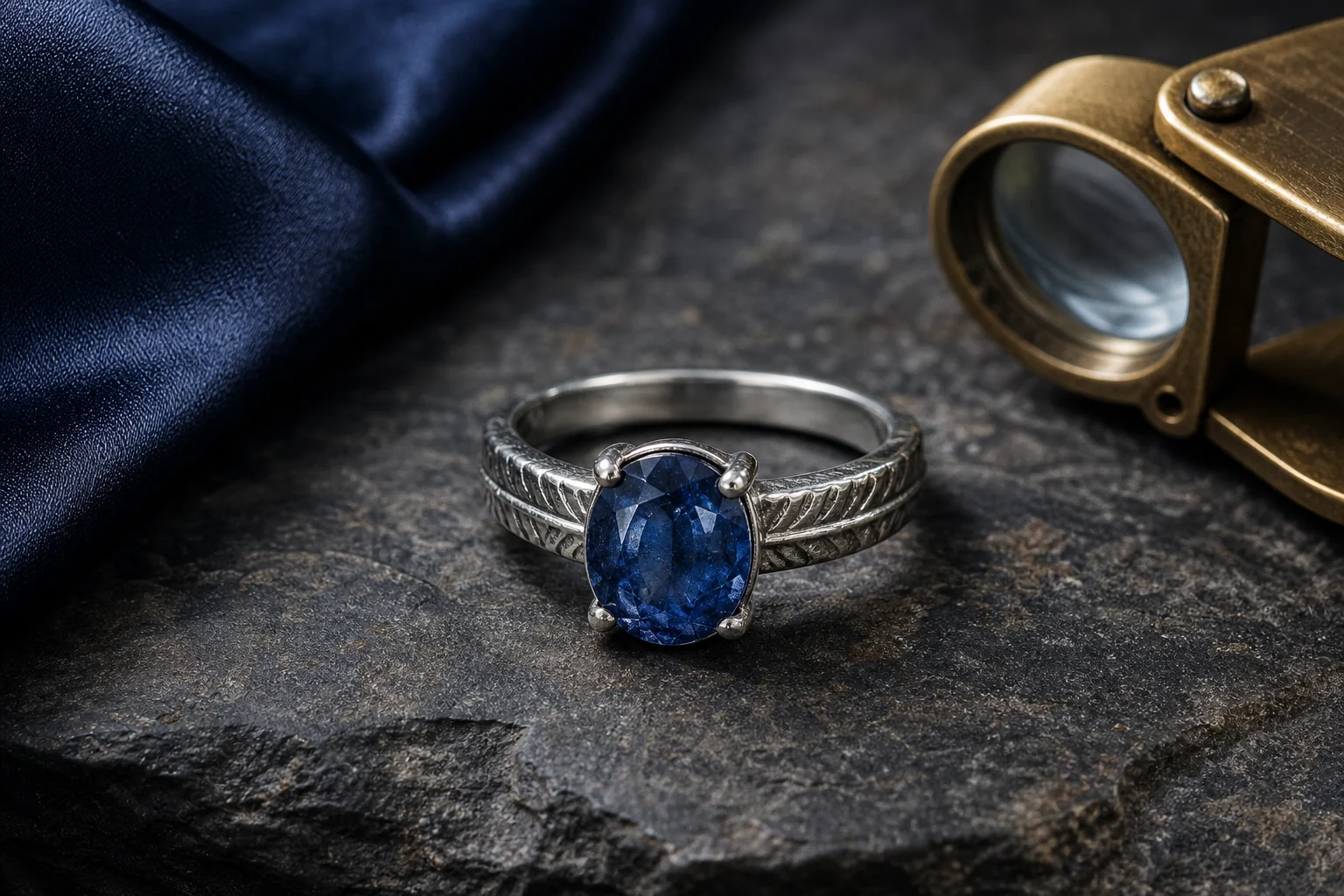
Neelam, or blue sapphire, is the gemstone most closely tied to Saturn (Shani) in Jyotish tradition. Astrologers who recommend it usually connect it with discipline, patience and steadier focus during a difficult Saturn period, not with guaranteed wealth or protection from every problem. It is also one of the costliest coloured stones in the trade, with an untreated stone from a historic mine selling for many times the price of an ordinary heat-treated one of similar size. Whether you should wear one, and which one, depends on your horoscope, your budget and how much documentation you are willing to insist on.
Ask five jewellers about Neelam and you may get five different answers on origin, treatment and price. That is exactly why this stone demands more homework than almost any other gemstone sold for astrological purposes. This piece goes through what tradition actually claims for Neelam, where the finest stones have traditionally come from, why a trial period is often advised before committing, what a lower-cost substitute looks like, and the specific signs that a seller cannot be trusted.
What benefits are traditionally associated with Neelam?

In Jyotish, Saturn is the planet of karma, labour, endurance and delay. Neelam is believed to help a person align with these qualities rather than escape them. The benefits most commonly mentioned by traditional astrologers include steadiness under pressure, patience with slow-moving situations, more disciplined work habits, and clarity around duty and responsibility. Some traditions also describe it as useful support during a difficult Saturn transit or during Sade Sati, when Saturn is believed to test a person's patience and resolve over an extended period.
Online, you will also find much bigger claims: sudden financial windfalls, instant authority at work, protection from every accident, or a sharper mind overnight. None of these can be guaranteed, and no gemstone dealer or astrologer with genuine standing will promise them. Jyotish itself treats gemstone therapy as a supportive nudge, not a replacement for effort, ethics or the karma a person is already working through. If a seller frames Neelam as a shortcut that removes the need for anything else, that claim goes well beyond what the tradition itself asserts.
Does everyone need to wear blue sapphire?
No. Wearing a gemstone is entirely optional in Jyotish, and it is usually presented as one option among several rather than a requirement. Prayer, fasting on Saturdays, charity toward the underprivileged, mantra recitation and ethical conduct are remedies that cost nothing and are available to everyone, regardless of whether they can afford a certified sapphire. Many astrologers will actually suggest trying these gentler Sade Sati remedies first, since gemstone therapy is considered a more direct and, according to tradition, a more intense way of engaging with a planet's energy.
Where Neelam comes from: Kashmir, Ceylon and Burma
Origin matters enormously for blue sapphire, both in traditional reputation and in resale value, and this is one of the least understood parts of buying Neelam. Three regions are traditionally prized above all others.
Kashmir sapphires were found in the Zanskar range of the Himalayas after a landslide exposed the deposit around 1881. The mines produced intensely for a few decades and were essentially exhausted by the 1930s. Every Kashmir sapphire sold today, therefore, is old stock, and its soft, velvety cornflower-blue colour, caused by fine internal rutile inclusions that diffuse light, is considered the finest expression of the stone by gemologists and collectors alike. Burmese sapphires, mined around Mogok in Myanmar, tend to show an intense, slightly violet-toned blue and are prized for their saturation, sometimes rivalling Kashmir material. Ceylon (Sri Lankan) sapphires are the most widely available of the three, ranging from pale to a bright, electric blue, with generally fewer inclusions and greater brilliance than Kashmir stones.
| Origin | Traditional character | Availability today | General price tendency |
|---|---|---|---|
| Kashmir | Soft, velvety cornflower blue | Extremely limited; mines exhausted since the 1930s | Highest; can run several times the price of a comparable Ceylon stone |
| Burma (Myanmar) | Intense, slightly violet-blue | Limited, mined mainly around Mogok | Notable premium over standard Ceylon material |
| Ceylon (Sri Lanka) | Bright, versatile blue | Most widely available in the market | Wide range, from modest to very high depending on quality |
According to the Gemological Institute of America, origin claims for sapphire can only be reliably confirmed through advanced laboratory analysis, not through appearance alone, and Kashmir origin in particular commands a substantial premium precisely because of this scarcity and the difficulty of verifying it. If a seller tells you a stone is from Kashmir or Burma, ask which laboratory confirmed that, because the claim alone adds no value without a report to back it up.
Why should you be careful before buying?
Blue sapphires vary enormously in quality, origin, treatment and price, sometimes by a factor of a hundred or more for stones that look similar to the untrained eye. Before you spend anything meaningful on Neelam, get an independent gemological laboratory report, understand exactly whether and how the stone has been treated, and set a firm budget before you start looking rather than after you have fallen for a particular stone.
It helps to ask the seller these questions directly and in writing:
- Is the stone natural, synthetic, or a composite (assembled) stone?
- Has it been heated or otherwise treated, and is this stated clearly on the invoice?
- Which independent laboratory issued the report, and can the report number be verified on that laboratory's own website?
- If a specific origin such as Kashmir, Burma or Ceylon is claimed, which laboratory confirmed that origin?
- What is the return policy if a second, independent opinion disagrees with the seller's claims?
A seller who hesitates, changes the subject, or cannot answer these plainly is telling you something important about how the rest of the transaction is likely to go.
What does colour, clarity and treatment actually mean?
Colour and clarity affect both the look of the stone and, in tradition, the astrological suitability that some astrologers claim to read from it, though this second point is a matter of belief rather than anything verifiable. In the trade, heat treatment is extremely common for blue sapphire and is generally accepted as long as it is disclosed, since it can improve colour and clarity without changing the stone's fundamental identity as a natural sapphire. What should never happen is a heated stone being sold as untreated, or a synthetic (lab-grown) sapphire, which is chemically similar but produced in weeks rather than formed over millions of years and worth a small fraction of the price, being sold as natural.
There is also a category of composite or assembled stones, sometimes called doublets, where a thin layer of genuine sapphire is fused to glass or a lesser material to imitate a larger, finer gem. A proper laboratory report will state plainly whether a stone is natural, synthetic, or composite, and whether it has been heated, and this single document is worth more than any verbal reassurance from a seller.
The trial-wearing period many astrologers recommend
A detail that often gets left out of shorter guides on Neelam is the trial period that many Vedic astrologers recommend before a person commits to wearing the stone regularly. Tradition holds that Neelam can act quickly compared with other gemstones, and for that reason a trial of roughly three to seven days is often suggested first. One common method is to tie the stone in a small piece of blue or black cloth and wear it on the upper arm, or keep it under the pillow at night, rather than setting it into a ring immediately.
During this window, the advice is to pay attention to sleep quality, mood, and any small events in daily life. Calm sleep, a settled mood or minor good news are traditionally read as signs the stone may suit the wearer. Restlessness, bad dreams, headaches or a run of small setbacks are read as signs that it may not, and astrologers following this tradition generally advise removing the stone and reconsidering rather than pushing through discomfort in the hope that it will settle. This is a matter of astrological custom, not a medically established effect, but it is worth knowing about since it is such a widely repeated part of how Neelam is traditionally worn.
Neelam or a substitute stone: what about Amethyst?
Because a fine natural sapphire is expensive and carries real buying risk, many astrologers suggest an upratna, or substitute gemstone, as a gentler and more affordable starting point. Amethyst, sometimes called Jamunia, is the substitute most commonly recommended for Saturn, alongside iolite for those with more material rather than spiritual goals. According to Gemstoneuniverse, Amethyst is treated as carrying a milder version of Saturn's association and is generally set in silver, worn in a larger carat weight than Neelam would require, often five to ten carats, with a deep purple colour showing blue undertones rather than a pale lavender.
Amethyst is not considered equal in strength to a fine natural sapphire in this tradition, but it costs a fraction of the price and carries much less risk if it later turns out not to suit the wearer. For someone who is uncertain about committing to Neelam, or who wants to test the idea of gemstone therapy before spending significantly, this is a reasonable place to start. It is also worth comparing gemstone options against other Shani-linked items some people consider, such as an iron ring; our separate guide on Shani ring benefits covers that comparison in more detail.
Is there a correct metal, finger or day?
Practices differ across regions and lineages, and there is no single universally agreed rule. Some traditions call for the stone to be set in gold, others prefer silver or a mix of metals. Some recommend the middle finger of the right hand, others the ring finger. Saturday is the day most commonly suggested for first wearing the stone, in keeping with Saturn's association with that day, often after a period of energising or purification through prayer. These are devotional conventions passed down through particular family or astrological traditions, not fixed universal laws, so it is reasonable to follow whichever practice your own astrologer or family tradition observes rather than assuming there is one correct answer.
Red flags that suggest a seller cannot be trusted
Beyond the specific questions to ask about certification, there are broader warning signs worth watching for when shopping for Neelam, particularly online.
- A price that is unrealistically low for the carat weight and origin claimed, especially if the stone is described as untreated or from a historic mine like Kashmir.
- Refusal to allow independent testing, or resistance when you mention getting a second opinion from another laboratory.
- A certificate from a laboratory you cannot find or verify online, or one that cannot produce a matching report number on its own website.
- Guaranteed outcomes tied to the purchase, such as promises of a promotion, a court case win, or a marriage, if you buy today.
- Heavy urgency, such as claims that the stone is the last one available or that a special price expires within hours.
- A vague website with little information about the business, no clear return policy, and only a single low-quality photo of the stone.
None of these signs alone proves fraud, but two or three together should make you pause and look elsewhere.
How can you approach the decision thoughtfully?
Start by deciding honestly whether you genuinely want to wear a gemstone, rather than feeling pushed into it by an anxious moment or someone else's strong opinion. If you do decide to go ahead, choose a jeweller with a real, checkable reputation, ask for full documentation before you pay anything, and set your budget in advance so you are not persuaded to stretch it once you are emotionally attached to a particular stone. It can also help to speak with an astrologer who has no financial stake in which gemstone you eventually buy, since a seller who is also giving you astrological advice has an obvious conflict of interest.
When should you walk away?
Walk away the moment a seller uses fear to push a sale, refuses independent testing, promises a guaranteed life outcome, or pressures you to borrow money or spend beyond what you can comfortably afford. A stone bought under pressure rarely brings the sense of calm and discipline that Neelam is supposed to represent in the first place, whatever tradition you follow.
Conclusion
Neelam carries a genuine and long-standing place in Jyotish tradition, associated with steadiness, patience and disciplined effort under Saturn's influence, not with instant fortune. Its price and reputation are shaped heavily by origin, whether Kashmir, Burma or Ceylon, and by treatment, so documentation matters more here than with almost any other gemstone. A trial period, a lower-cost substitute like Amethyst, or simply choosing prayer and ritual instead are all legitimate paths within the same tradition. Perhaps the most reliable benefit of engaging seriously with Neelam is not the stone itself, but the more considered, patient relationship with discipline and intention that the process of choosing it carefully can encourage.