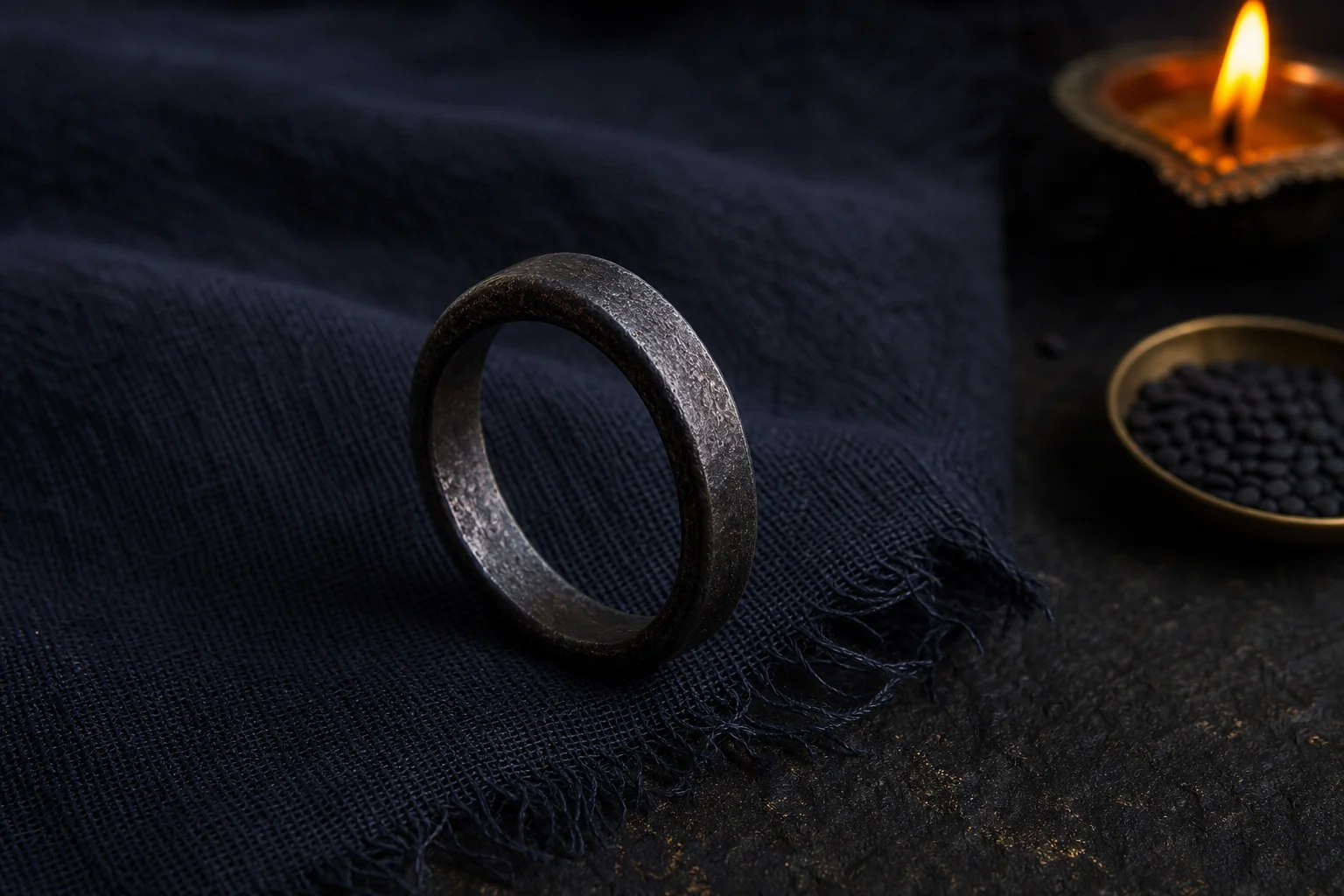
A Shani ring is a devotional object, usually forged from iron or cast from panchdhatu, a five-metal alloy, worn by some devotees as a personal symbol of Saturn's qualities: discipline, patience and steady acceptance of karma. The most recognised form in North India is a ring made from the shoe of a black horse, called ghode ki naal ki anguthi, though plain iron bands and panchdhatu rings are sold just as widely today. No tradition describes a ring as guaranteeing wealth, romance, health or protection from harm. What it offers, according to belief, is a reminder to hold discipline through a demanding period, nothing more concrete than that.
Here is the tension worth naming early. The rules repeated most confidently online, cold-forged iron, two combined sources of metal, three separate Saturdays, sound impressively precise. Very little of that precision shows up anywhere outside the websites that sell the rings. That is worth knowing before paying extra for a version marketed as more complete than a plain one.
What is a Shani ring, and why is it linked to Saturn?
A Shani ring is any ring worn specifically to mark a devotee's relationship with Saturn, most often forged from iron or cast from panchdhatu. In several schools of Jyotish, Shani Dev is described as Karmaphaladata, the deliverer of the fruits of a person's own past actions, not a force acting at random. The Navagraha entry in Encyclopaedia Britannica describes Saturn within the navagraha system as linked to asceticism, penance, discipline and conscientious work, themes closer to a stern teacher than an arbitrary punisher.
Iron's link to Saturn goes back further than the ring trade. In Yajnavalkya Smriti, one of the classical sources on planetary worship, iron is named as the material for Saturn's own ritual image. That textual root, the metal used to represent the deity rather than the metal given away as charity, is very likely one origin of iron's wider association with Shani Dev. The ring itself, as an everyday object devotees wear, is a later and far more regional development than a scriptural instruction.
Even within the older texts, iron's ownership is not perfectly settled. Some passages assign iron as a donation item to Rahu rather than Saturn, while separately naming iron as Saturn's own image material. Traditions do not always agree with each other on this point, and an honest account says so rather than picking whichever version is more convenient to repeat.
The iron ring and the ghode ki naal horseshoe tradition
The best-known Shani ring in North India is not plain iron at all. It is forged from the shed shoe of a black horse, ideally one that wore and lost the shoe naturally rather than new stock bought from a farrier, and it is called ghode ki naal ki anguthi. Some smiths combine horseshoe iron with nails salvaged from an old, broken-up boat, on the reasoning that both metals have already been battered by the world before becoming a ring.
Living practice, recorded mostly in North India and Punjab, attaches a specific set of timing rules. The iron should be obtained on a Saturday, the ring forged on a Saturday, and it should be worn for the first time on a Saturday. The metal is meant to be worked cold and never heated over a fire, because Saturn is associated with cold, dark and slow qualities, and passing his metal through fire is said to hand it over to the registers of the Sun and Mars instead.
The ring is traditionally worn on the middle finger, right hand for men and left hand for women. A second, unworked horseshoe is often nailed whole above the main door of the house, a household practice kept separate from the personal ring.
This custom is strongest in North India and Punjab, present in a milder form in Maharashtra, and considerably weaker in Tamil Nadu and Andhra Pradesh, where Shani worship follows a different regional shape built around temple rites rather than a household object. If your only exposure to the horseshoe ring has been through a seller's website, it helps to know it belongs to a specific region of the country rather than to Hindu practice everywhere.
The elaborate, multi-step version, two sources of iron, strict cold-forging, three separate Saturdays, is the one repeated almost exclusively by people selling the finished ring. Every added rule happens to make a plain iron ring insufficient and the seller's more complicated version necessary. That pattern is worth noticing on its own, regardless of what you decide to buy.
If you would rather have a puja performed than buy a ring

Not everyone who wants to honour Shani Dev wants to wear an object, and a ring has never been a requirement for that devotion. An alternative many devotees choose is a priest-led puja performed on their behalf, with the ritual made transparent rather than assumed.
Panchdhatu rings and other styles sold today
Panchdhatu is the more commercial alternative to a plain iron ring, an alloy blending five metals, typically gold, silver, copper, iron and tin or zinc, said to represent the Sun, Moon, Mars, Saturn and Mercury together in one object. Sellers describe it as gentler than committing to a single strong planetary object, aimed at someone who does not want to choose one metal or one gemstone alone.
That framing is a modern retail one rather than an ancient prescription. Five-metal alloys exist in older metallurgical and ritual traditions for other purposes, but panchdhatu marketed specifically as a multi-planet astrology ring is a comparatively recent product category. It should be understood as such rather than dressed up as scripture it was never part of.
The table below sets out the main styles sold as Shani rings today, with rough price bands and the caution that matters most for each.
| Ring type | Typical material | What tradition claims | Typical price range (India) | Main caution |
|---|---|---|---|---|
| Plain iron band | Forged iron | A direct, simple link to Saturn's metal | Roughly ₹300 to ₹1,500 | Quality and finish of the iron vary widely between sellers |
| Ghode ki naal ring | Shed horseshoe iron, sometimes with boat nails | Salvage symbolism, Saturday timing, cold-forging | Roughly ₹500 to ₹3,000 | Elaborate multi-step specifications are usually a sales device, not an old rule |
| Panchdhatu ring | Gold, silver, copper, iron, tin or zinc alloy | Said to balance several planetary influences at once | Roughly ₹1,500 to ₹8,000 or more | Actual metal ratios are rarely disclosed or independently verified |
| Gemstone-set ring | Iron or panchdhatu band set with a stone, often neelam | Combines a gemstone's believed effect with the metal | Roughly ₹5,000 to well over ₹1,00,000 | Stone quality and treatment need independent certification, see our Neelam guide |
Prices vary by city, workmanship and how the seller markets the ring, so treat these as a rough orientation rather than a fixed quote.
What people traditionally hope a Shani ring will support
Devotees who choose to wear a Shani ring are usually hoping for support with discipline, focus and the ability to sit with a demanding or delayed period, not a change in outcome by itself. Traditional belief connects the ring to steadiness during a hard patch, a Sade Sati transit, a demanding Shani dasha, or an ordinary run of bad luck that has nothing to do with astrology at all.
Some devotees say that touching the ring reminds them to keep a promise, finish an unpleasant task, or stay patient with a slow process rather than forcing it. These are matters of personal and traditional belief. They are not medically or scientifically demonstrated effects, and a ring should never be treated as a substitute for treatment, sound financial decisions or personal effort, the same caution that applies to Neelam, our guide to blue sapphire.
If you are wearing a ring because a reading mentioned Sade Sati or a similar transit, it is worth understanding what that period actually means before assuming the worst. Our guides to Sade Sati remedies and Shani Dosha remedies explain what is traditionally recommended, and why a fear-based framing of either term deserves suspicion rather than trust.
Buying a Shani ring without pressure: purity, budget and seller
If you decide a Shani ring is right for you, the practical decision is separate from the spiritual one: what metal purity are you actually paying for, and can the seller prove it. For gold or silver components, India's hallmarking system is the relevant, checkable standard.
Since 2021 the Bureau of Indian Standards has required a registered jeweller to mark gold jewellery with a BIS logo, a caratage and fineness mark, and a six-digit HUID number, with mandatory hallmarking extended to silver jewellery from 2025, according to the Bureau of Indian Standards' own hallmarking overview. Plain iron and panchdhatu rings sit outside hallmarking, since the scheme applies only to gold and silver, so a hallmark on a small gold accent tells you nothing about the iron core of the ring itself.
The Ministry of Consumer Affairs' phased rollout of mandatory hallmarking exists precisely because unverified purity claims were common enough to need a government-backed fix. That is worth remembering before paying extra for a ring described as pure panchdhatu or ritually superior iron with no way to check either claim independently.
Before paying for any Shani ring, especially an expensive one, ask the seller a few plain questions:
- What exactly is the metal, and can that be confirmed independently rather than taken on the seller's word alone?
- If gold or silver is part of the design, is it BIS hallmarked, and does the HUID number match the invoice?
- Is there a clear return policy if the ring does not match what was promised?
- Does the price reflect the metal and workmanship, or mostly a story about how sacred or complicated the ring's preparation was?
- Would the seller still respect your decision if you chose not to buy anything at all?
A reasonable seller answers these questions without becoming defensive. Set a budget you are genuinely comfortable with before you walk in, and treat that number as final rather than something a good story can talk you past.
When should you walk away?
Walk away the moment a seller pairs a frightening diagnosis with the one ring that supposedly fixes it. Be cautious of anyone who tells you, often within minutes of meeting you, that your career, marriage or health problems are being caused by an afflicted Saturn, and that only their specific ring, blessed in a particular way, can help.
That sequence, fear first, expensive solution second, is the exact pattern that responsible voices within the tradition warn against. It has nothing to do with Shani Dev being Karmaphaladata, the deliverer of the fruits of your own actions rather than a force that can be bribed or must be feared into submission.
Other signals worth noticing: a seller who refuses to let you check the metal independently, who discourages a second opinion, who insists you must buy today because the muhurat will not come again for months, or who sells you a ring, a gemstone and a yantra in the same conversation. None of that is devotion. It is a sales technique borrowing devotional language.
Is a ring necessary to worship Shani Dev?
No. A Shani ring is entirely optional, and sincere devotion does not require wearing one, buying one, or being able to afford one. Prayer at home, a lit lamp, honest conduct and simple charity are complete forms of worship on their own, with or without an object on your finger.
If you want a fuller practice without buying anything first, our guide on whether you can perform Shani puja at home and our plain explanation of how to please Shani Dev cover what is genuinely traditional. For those who want a priest-led rite but cannot travel to a temple or a centre in person, the step-by-step Shani puja vidhi explains what a proper ritual actually involves, so you can judge any priest-led offering, ours included, against a clear standard rather than a sales pitch.
Conclusion
A Shani ring, whether a plain iron band, a horseshoe forged into ghode ki naal ki anguthi, or a modern panchdhatu alloy, is a devotional object rooted partly in real textual associations and partly in living regional custom. Iron's link to Saturn traces back to its use as Saturn's own image material in classical texts, while the elaborate rules sold today, cold-forging, two sources of metal, three Saturdays, come mostly from the market rather than scripture. No ring changes karma, guarantees an outcome, or substitutes for effort, medical care or financial sense. If you choose to wear one, buy it from someone who welcomes questions, check any gold or silver component against its BIS hallmark, and treat the ring as a personal reminder of discipline rather than a transaction with fate.