
Wearing black or dark blue on Saturday is a common Hindu practice linked to Shani Dev, the deity associated with the planet Saturn. The belief holds that black is Shani's preferred colour, so wearing it on his day is thought to align a person with the qualities he represents: discipline, patience, and impartial justice. It is a devotional custom rather than a scriptural rule, and plenty of sincere devotees skip it without any sense of failing at worship.
Here is the real tension in this tradition though. Black is one of the only colours actively invited into Hindu practice on any single day. On almost every other occasion, weddings, housewarmings, festivals, even routine Tuesday and Friday worship, black is the colour most families deliberately avoid. Saturday carves out a rare, specific exception, and understanding why makes the custom far more interesting than a simple "wear this colour" instruction.
Where the Black-on-Saturday Custom Comes From
Tradition traces Shani's dark complexion back to a well known Puranic legend, not verified history, but a story repeated across Shani Mahatmya texts and popular retellings. Shani is described as the son of Surya, the Sun god, and Chhaya, who performed intense tapasya, or austerity, while carrying him, standing exposed to the sun for long stretches with little food or rest. Popular belief holds that this severe penance is what left Shani with a dark complexion at birth, and shaped him into a stern, disciplined deity who delivers the results of a person's own karma without favour or exception (Bejan Daruwalla).
Because black is associated with Shani in this way, wearing it on Saturday is treated as a small gesture of resonance, an outward nod to the inward qualities of restraint and seriousness that Shani is said to reward. Dark blue carries much the same meaning in most accounts, since both colours are linked to Saturn's grave, methodical character rather than to celebration or ornament (News9Live).
Shani's iconography reinforces the same idea visually. He is traditionally shown with a dark complexion, dressed in black or dark blue robes, holding a sword or sceptre, and riding a crow or vulture, a bird associated in this imagery with watchfulness, since it is said to carry word of a person's conduct back to him. The picture is less about menace and more about impartial observation: a deity who notices everything and responds to conduct rather than to appeals, flattery, or bargaining.
Is It Compulsory to Wear Black on Saturday?
No, wearing black on Saturday is not compulsory, and no Hindu scripture makes it a condition for valid worship. It is best understood as a custom that some families and individuals follow out of personal devotion, the same way some people fast on Saturdays or avoid starting new ventures that day, rather than a rule with a penalty attached for skipping it.
This matters because fear around missed rituals is exactly the kind of pressure worth questioning. If you forgot to wear black last Saturday, or you simply do not own dark clothing, that has no bearing on your sincerity or on how your prayers are received. The same principle applies to visiting a physical Shani temple: you do not need to visit a Shani temple to pray sincerely, and you do not need a particular wardrobe either.
What to Wear Instead, and How the Other Days Work
If black feels wrong for you, dark blue, charcoal grey, or deep purple are treated as acceptable substitutes, since the underlying idea is a sober, restrained tone rather than one exact shade. Each day of the week carries its own colour association in this same tradition, tied to the ruling planet rather than to Saturn specifically:
- Sunday: red or orange, linked to the Sun
- Monday: white, linked to the Moon
- Tuesday: red, linked to Mars
- Wednesday: green, linked to Mercury
- Thursday: yellow, linked to Jupiter
- Friday: white or light pink, linked to Venus
- Saturday: black or dark blue, linked to Saturn
None of these are enforced dress codes. They function more like a weekly rhythm some devotees choose to observe, similar to eating a particular way on a fasting day, and dropping the practice on a given week changes nothing about a person's standing in their faith (News9Live).
Regional and Family Variations in the Practice
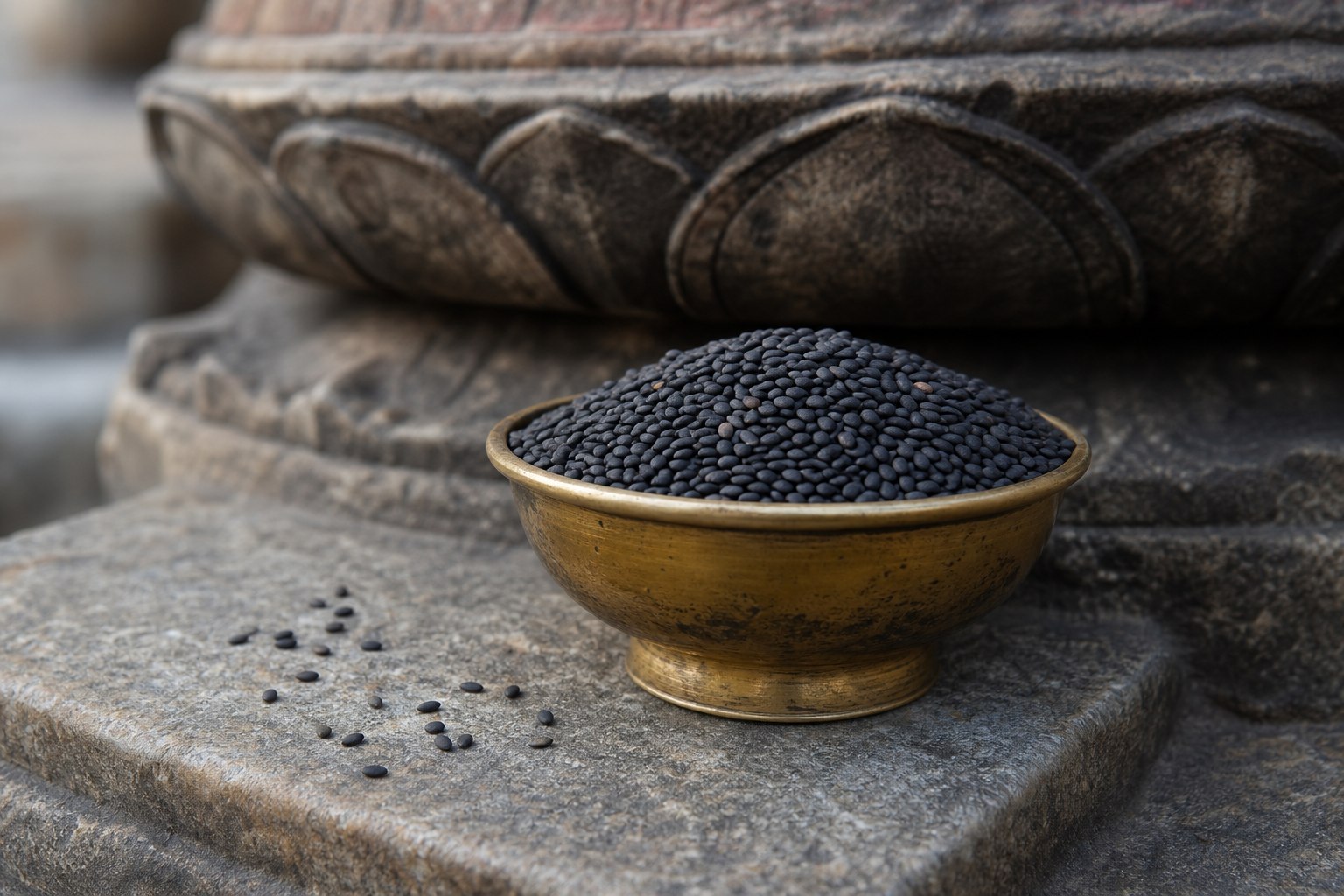
Plenty of families do not wear black on Saturday at all, and the reasons are usually about local custom rather than any disagreement over Shani himself. Several South Indian Brahmin households, for instance, treat black as inauspicious for daily wear on principle and instead express Saturday devotion through offerings rather than clothing. This usually means donating black items, black sesame seeds known as til, black urad dal, black cloth, iron, or mustard oil, to the poor or at a Shani temple, which is considered at least as meaningful as wearing the colour (Bejan Daruwalla). For a fuller list of what is traditionally offered, see what to offer Shani Dev on Saturday.
Other families follow the practice loosely, wearing black only when they remember, or reserving it for Saturdays that fall during a Sade Sati period or a specific dosha remedy window. None of this is a contradiction. Hindu devotional practice has always allowed regional and family variation, and Shani worship in particular has no single centralised authority dictating a uniform dress code across India.
Does Going Through Sade Sati Change This Advice?
If you are going through Sade Sati, the roughly seven-and-a-half-year Saturn transit some believe intensifies Shani's effects, wearing black weekly is still generally treated as an acceptable practice rather than something to avoid. The more specific caution some astrologers give is around buying new black clothing or leather items specifically on Saturdays and Tuesdays during this period, not around wearing black you already own for worship.
Because advice like this depends on a person's actual birth chart and which phase of Sade Sati they are in, it is worth checking against what Sade Sati actually means for your chart or working it out with a Sade Sati calculator rather than following a blanket rule picked up secondhand.
What Actually Matters More Than the Colour
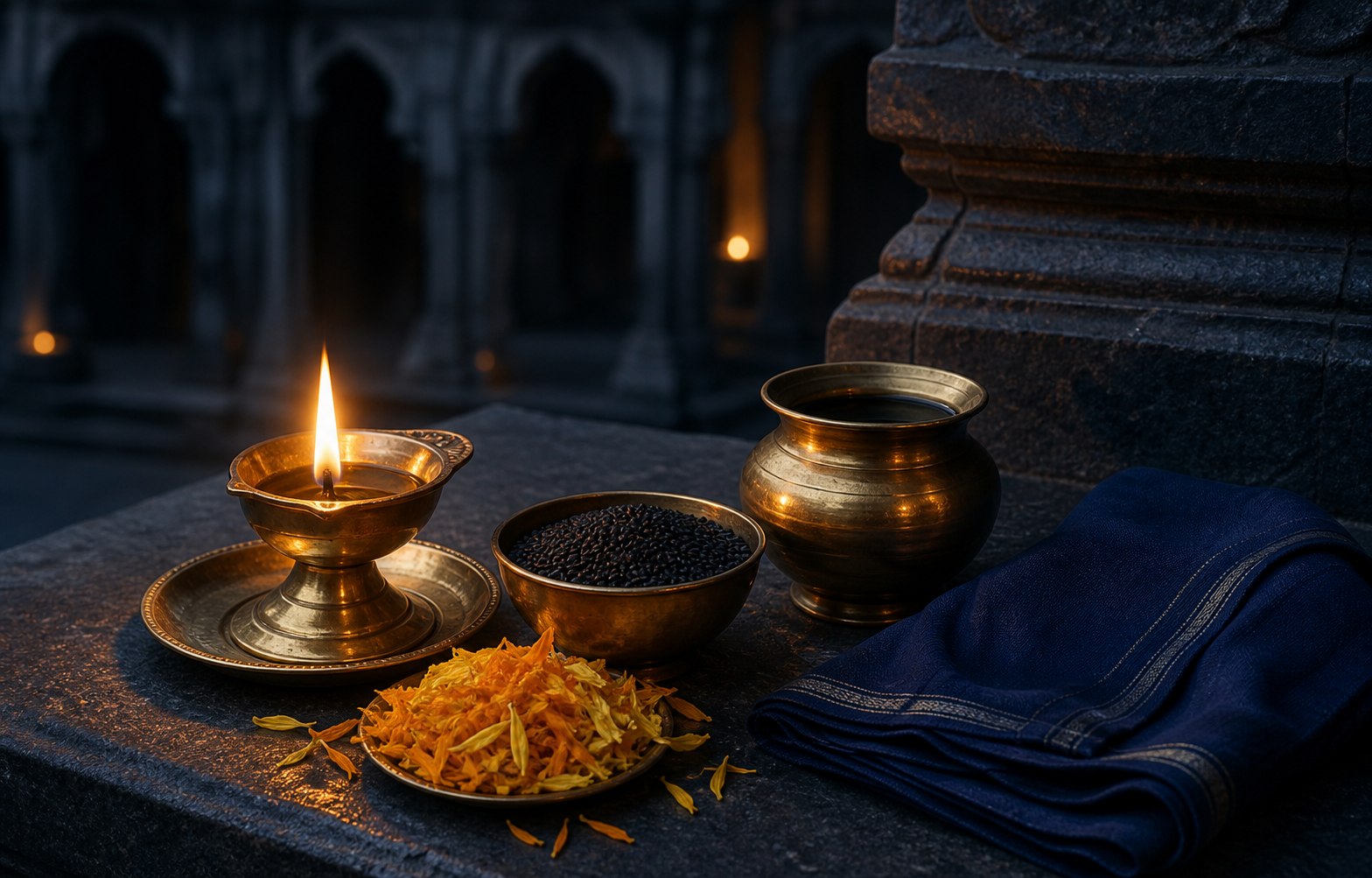
The colour of your clothes is a minor detail next to the ritual elements that Shani worship is actually built on. Til Tel Abhishek, anointing Shani's murti or a lamp with sesame oil, is considered one of the most significant acts of the ritual, since sesame oil is described as especially dear to Shani because of its association with austerity and discipline (Shri Shaneshwar Devta Mandir). Alongside the abhishek, Shani Mantra Jaap, Deepdaan, or offering a lit lamp, and a Sankalp naming the devotee and their gotra form the core of a proper Saturday puja, whether performed at home, at a temple, or on your behalf elsewhere. The mantra most commonly recited during this jaap is Om Sham Shanicharaya Namah, repeated in a fixed cycle as part of the same Sankalp process, and the words themselves carry more devotional weight than any outward detail like clothing colour.
For the full step-by-step sequence these elements follow, Shani puja vidhi sets it out in order, and Shani puja mantra explained breaks down what the mantra means and why it is repeated the way it is. The larger point is that discipline, honest effort, and consistent devotion are what the tradition is actually pointing toward. Black clothing is a visual reminder of that discipline, not a substitute for it, and no colour of shirt makes up for skipping the substance of the ritual altogether.
Conclusion
Wearing black or dark blue on Saturday is a genuine part of Shani Dev devotion, rooted in the belief that black resonates with Saturn's disciplined, austere character, and traced in tradition to the Puranic account of Shani's own dark complexion at birth. It is a custom, not a rule, and families vary widely in how strictly they follow it, some substituting donations of black til or oil instead of clothing altogether. Dark blue, grey, or purple work as reasonable substitutes when black is not practical or not part of your family's custom. What the tradition actually asks for, sincerity, consistency, and the core rituals of Til Tel Abhishek, mantra jaap, deepdaan and sankalp, matters far more than the exact shade you happen to be wearing.