
Shani Jayanti 2026 was observed on Saturday, 16 May 2026, during Jyeshtha Amavasya, the new-moon day of the Hindu month of Jyeshtha. That date has already gone by, since today is 21 July 2026, so what follows is written as a clear record of what happened and a guide for anyone trying to understand the observance properly, not a countdown. Because the day also fell on a Saturday, which is traditionally Shani Dev's own day, many families treated it as an especially meaningful moment for prayer, fasting and charity.
Few figures in Hindu tradition carry as much unease as Shani Dev. Mention his name and most people jump straight to stories of delay, hardship and years of struggle before anyone gets to the deeper idea behind the day. Shani Jayanti, looked at honestly, is less about fear and more about an honest look at our own conduct. It rewards patience far more than it rewards panic.
What is Shani Jayanti? The birth story of Shani Dev
Shani Jayanti marks the birth anniversary of Shani Dev, the deity associated with the planet Saturn, karma, justice, discipline and the consequences of our actions. The story behind his birth is one of the more layered ones in Hindu mythology, and it explains a good deal about why Shani is portrayed the way he is.
According to tradition, Shani Dev is the son of Surya, the Sun god, and Chhaya. The story goes that Surya's first wife, Sanjna, found it hard to bear the intensity of her husband's radiance. Before withdrawing, she created a double of herself from her own shadow, named Chhaya, and asked her to take her place. While carrying Shani, Chhaya undertook long, severe tapasya directed at Lord Shiva, and this discipline is said to have shaped the child growing within her. Shani is described as being born with a dark complexion and a nature inclined towards deep meditation, both traced back to his mother's austerity.
One detail devotees often bring up is the moment of his birth. It is said that the moment Shani first opened his eyes and looked towards his father, Surya's brilliance visibly dimmed, a detail retold in several accounts of the Surya-Shani relationship. When Surya later realised that Chhaya was not Sanjna, the relationship between father and son grew distant and difficult, and this tension is often given as one root of Shani's reputation for hardship and delay. Yamraj, the deity of death and judgment, is considered Shani's half-brother through Surya's first marriage, which is part of why Shani is so closely linked with accountability and the reckoning of one's deeds.
None of this is meant to be read as a threat. The more considered reading, and the one this article takes, is that Shani represents fairness rather than punishment. He does not play favourites, and that impartiality is exactly why he is respected rather than only feared. For more on how this plays out in a person's chart, see our piece on what Shani dosha actually means.
When was Shani Jayanti 2026 observed?
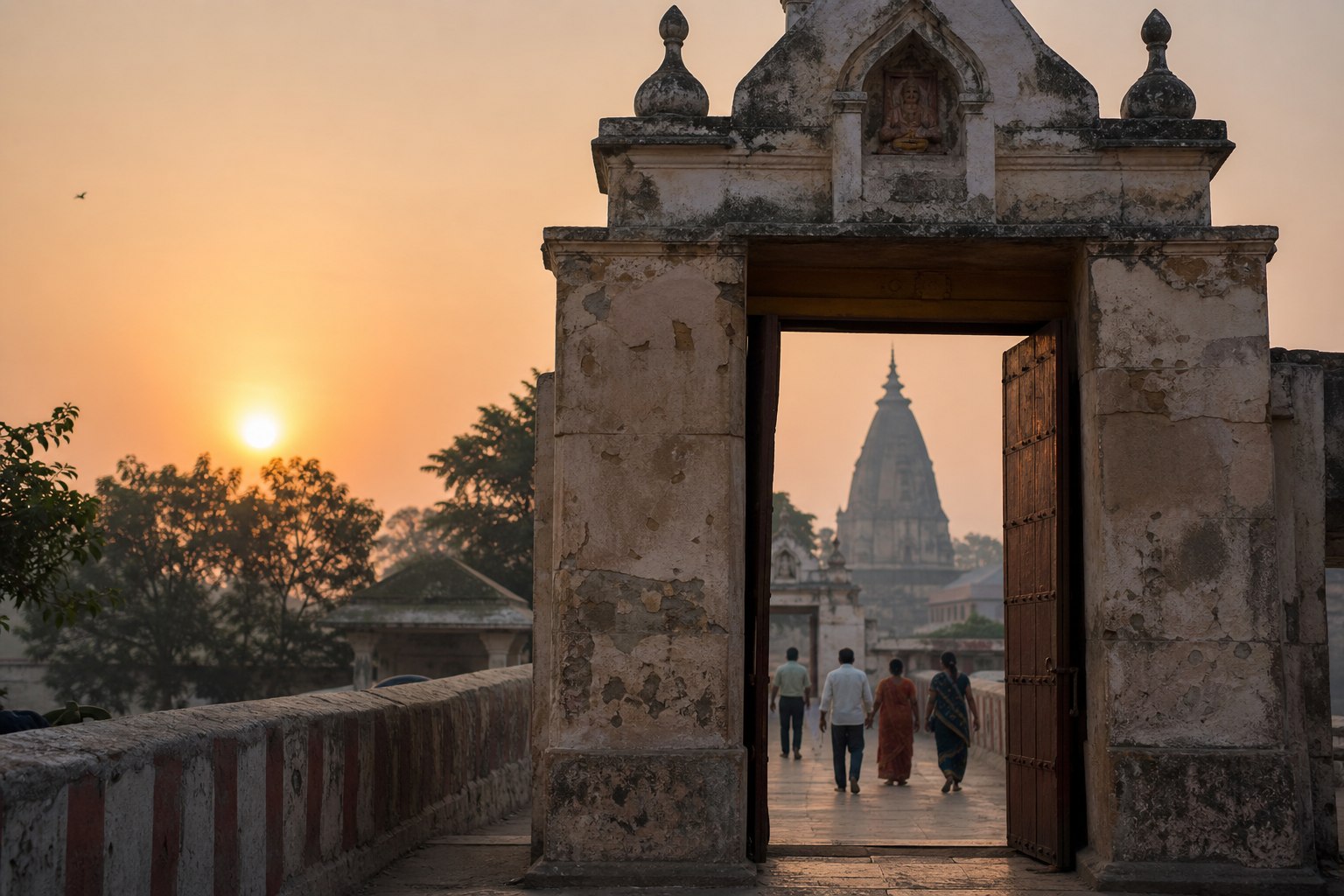
Shani Jayanti 2026 fell on Saturday, 16 May 2026. According to Drik Panchang, the Amavasya tithi began around 5:11 am on 16 May and continued until roughly 1:30 am on 17 May, though exact timings shift slightly depending on your city, so anyone checking a date in future should look up their own local panchang rather than rely on a single generic listing.
What made the 2026 date genuinely unusual is that it brought together three separate markers at once: Shani Jayanti itself, the Amavasya tithi, and a Saturday, Shani's own day. That kind of triple convergence does not happen every year. In several North Indian states, 16 May 2026 also coincided with Vat Savitri Vrat, the day married women traditionally observe by tying a sacred thread around a banyan tree for their husband's long life, so many households were juggling two observances on the same date.
That date has now passed. If you are reading this well after May 2026, the practical point still stands: worship, charity and self-discipline connected to Shani do not need to wait for one specific day on the calendar. This article will need a fresh date and tithi check ahead of the 2027 observance.
Temple, home or online: how people take part in Shani Jayanti puja
There is no single correct way to mark the day. Some devotees travel to a dedicated Shani temple, some prefer a quiet observance at home, and increasingly, some choose to have a priest perform the ritual on their behalf when travel simply is not realistic. All three are legitimate, and none is a shortcut or a lesser option than the others.
A temple visit can add a sense of occasion, particularly at a site associated specifically with Shani. Whether that is worth prioritising over a sincere home puja is really a personal decision. We go into this in more detail in do you need to visit a Shani temple, and the short answer is no, a temple is not a condition for genuine devotion.
Shani Jayanti, Shani Amavasya and Shani Trayodashi: three observances, not one
A lot of the confusion around Shani-related dates comes from three separate observances getting lumped together in casual conversation. They are related, but they are not interchangeable, and it helps to know which one you are actually reading about.
| Observance | When it falls | What it marks |
|---|---|---|
| Shani Jayanti | The Amavasya (new moon) of the Jyeshtha month, once a year | The specific birth anniversary of Shani Dev |
| Shani Amavasya (Shanichari Amavasya) | Any Amavasya that happens to fall on a Saturday, several times a year | A Saturday new moon, generally considered a good time for Shani-related worship and charity |
| Shani Trayodashi | Any Trayodashi (13th lunar day) that falls on a Saturday, occurring periodically through the year | A recurring day associated with easing hardship linked to Sade Sati, Shani Maha Dasha or Shani Dhaiya |
Shani Jayanti is always a Shani Amavasya as well, because it is an Amavasya, but not every Shani Amavasya is Shani Jayanti, since most of them fall in months other than Jyeshtha. Shani Trayodashi is a different tithi altogether and recurs more often through the year. If a friend mentions "Shani Amavasya" outside of the Jyeshtha month, they are most likely referring to one of these more frequent Saturday new-moon dates rather than the birth anniversary itself. If you are trying to work out whether a difficult phase in your life is connected to Sade Sati specifically, our Sade Sati meaning guide and Sade Sati calculator are more directly useful than any single date on the calendar.
How the observance varies across different parts of India
Shani Jayanti is not marked identically everywhere, and it is worth knowing this so a family does not feel they are "doing it wrong" if their customs differ from a neighbour's.
In many parts of North India, the day is closely tied to Saturday worship traditions already common in the region: offerings of mustard or sesame oil, a visit to the Ganga where that is practical, and, as mentioned above, an overlap with Vat Savitri Vrat in states such as Uttar Pradesh, Bihar and parts of Rajasthan. In Tamil Nadu and Puducherry, the focus often shifts to Thirunallar, home to the Saneeswaran temple, one of the nine Navagraha temples and widely regarded as India's principal site for Shani worship, according to its own temple history. Crowds there grow noticeably larger on Shani Jayanti and on ordinary Saturdays, and the temple also holds a separate festival every two and a half years when Shani transits into a new sign, a topic we cover in Shani transit 2026.
In Maharashtra, Odisha, Bengal and other regions, customs tend to be a mix of general Saturday practices, such as feeding crows (regarded as Shani's vahana), lighting oil lamps, and donating iron or black items, layered onto whatever the local temple or family tradition prescribes. There is no single authoritative version, and following your own family's or community's established custom is entirely sufficient. Reading about a practice from another part of the country is useful context, not an instruction to change what your own household already does.
A simple way to observe Shani Jayanti at home
A home observance does not need to be elaborate to be meaningful. A workable outline looks something like this.
- Set a simple sankalp, a short spoken intention, early in the day and clean the space where you intend to pray.
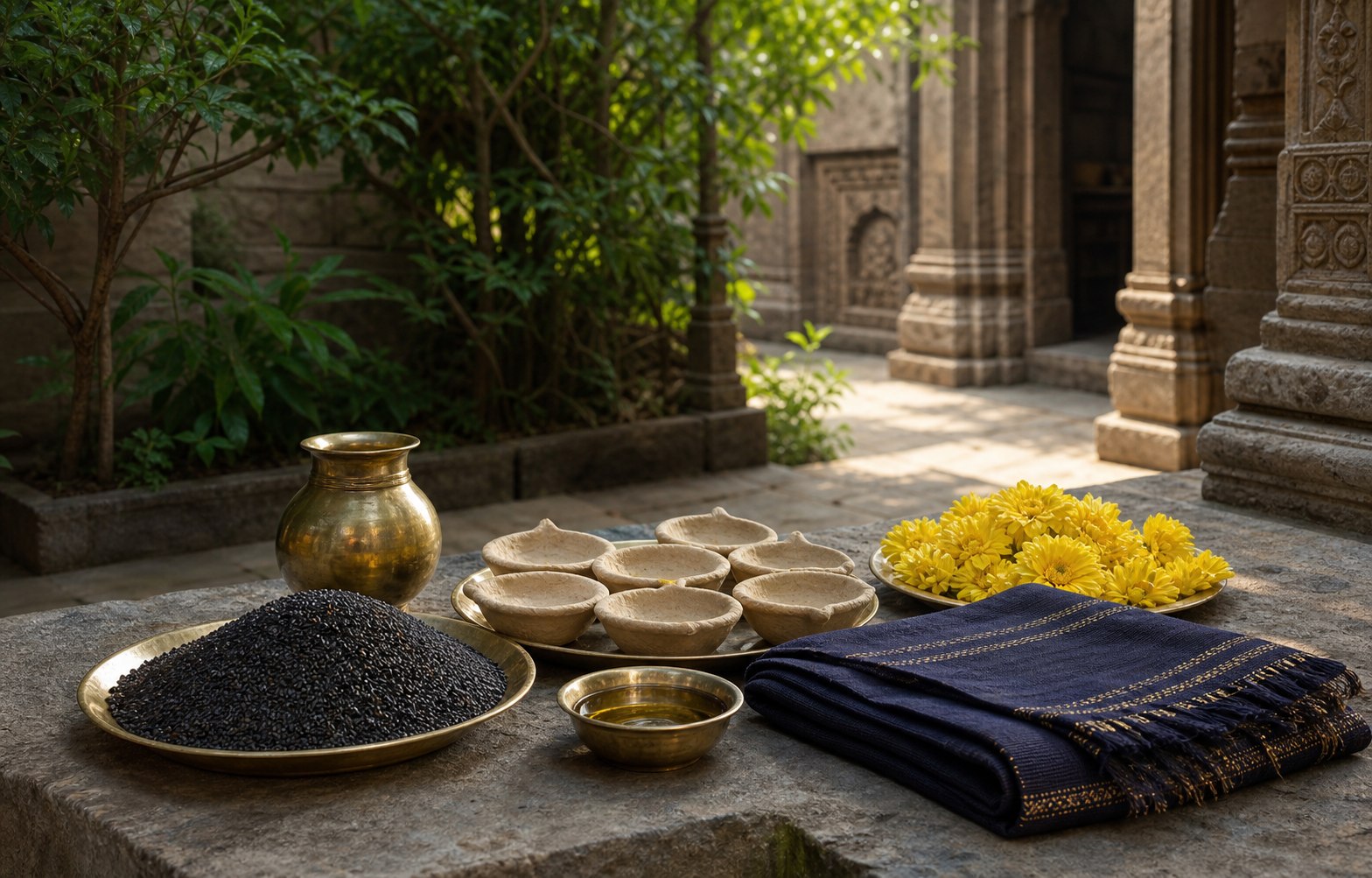
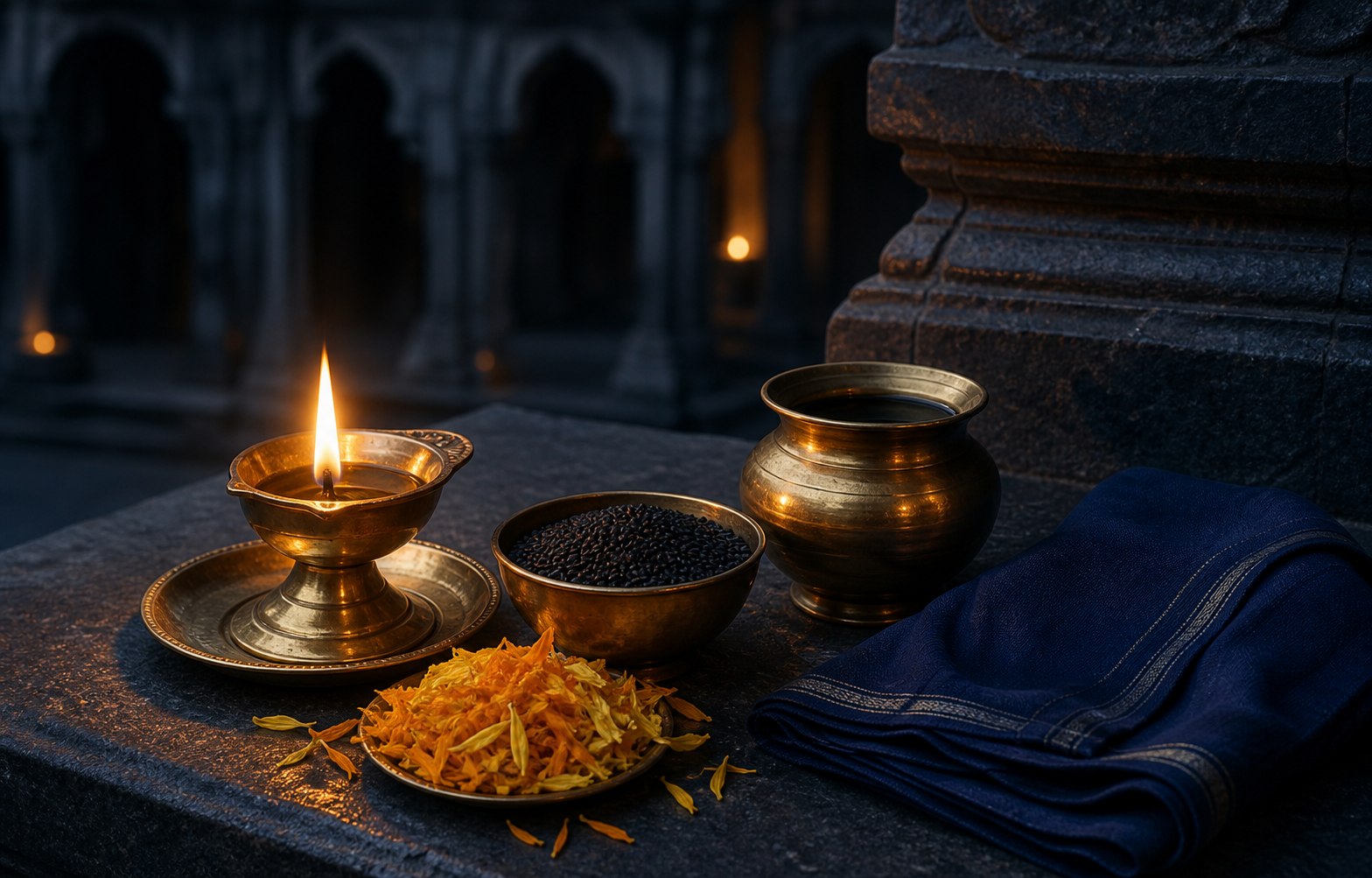
- Gather basic samagri if you have it to hand: mustard or sesame oil, a diya, black til (sesame seeds), and perhaps a small dark cloth. None of these need to be bought in bulk or from a specific shop; our Shani puja samagri list covers what is genuinely needed versus optional.
- Light the diya safely and let it burn through the prayer.
- Recite a prayer or mantra in whichever language feels natural to you, whether that is a short Shani mantra, the Shani Chalisa, or simply a few sincere words of your own. Our explanation of the Shani puja mantra walks through the meaning line by line if you want that context, and the full Shani puja vidhi is useful if you want a proper sequence to follow.
- Offer charity or practical help to someone who needs it, ideally in person and with dignity rather than as a transaction. Items like til, iron, black gram or oil are traditional, but a meal, warm clothing or simply your time count just as much; see what to offer Shani Dev on a Saturday for more specific ideas.
- Make one honest, practical commitment about your own conduct, patience or discipline, and actually try to keep it in the weeks that follow.
Do's and don'ts many devotees follow
Alongside the steps above, a number of customary do's and don'ts circulate around Shani Jayanti. None of them are commandments, and none should be treated as a source of anxiety.
Commonly followed practices include fasting if your health allows it, offering food to crows, donating black or iron items to someone in genuine need, keeping the day calm rather than confrontational, and avoiding needless arguments or harsh words, since the day is meant to be a reminder of fairness towards others.
Equally common avoidances include steering clear of buying gold or silver that day in some families, postponing haircuts or nail-cutting, holding off on signing major new agreements, and avoiding non-vegetarian food or alcohol if you are observing a fast. Some households also treat this as a day to skip weddings or other celebratory functions out of a general sense of restraint, though this varies a great deal by region and family.
If a particular custom does not suit your health, your household, or simply does not resonate with you, it is fine to leave it out. Nothing here should ever be presented as compulsory, and no honest spiritual practice should leave you feeling pressured into an expensive remedy or a specific purchase out of fear. If you want a broader view of remedies people associate with a difficult Shani period specifically, our guide to Sade Sati remedies and Shani dosha remedies covers that ground without the scare tactics.
Observing Shani Jayanti with young children or elderly family members
A household is rarely made up of people who can all observe a day the same way, and Shani Jayanti is a good example of where flexibility matters more than uniformity.
Fasting is generally not appropriate for young children, elderly relatives with health conditions, or anyone who is pregnant, unwell or on medication that needs food. A lighter meal, or simply avoiding one particular food for the day, can stand in for a full fast without anyone feeling excluded. Children can still take part meaningfully by helping to light the diya under supervision, saying a short prayer in their own words, or joining the charitable part of the day, such as packing food to give away. It helps to explain Shani Dev's story in plain terms, focused on fairness and patience, rather than dwelling on curses or punishment, which can genuinely frighten a young child without adding anything useful to their understanding.
For elderly family members, a quiet, seated observance, perhaps a few minutes of prayer or listening to a recitation rather than standing through a long ritual, is entirely sufficient. Charity and a shared family meal afterwards are activities everyone in the household can take part in regardless of age or mobility. Where an elderly parent cannot travel to a temple, or a busy young family cannot coordinate a home ritual on the exact date, a remote seva performed on their behalf, with a video and Seva Record sent back to the family, is a practical middle path rather than a compromise.
The deeper lesson of Shani Jayanti
Strip away the calendar details and the samagri lists, and Shani Jayanti asks a fairly direct set of questions. Are we fair to people with less power than us? Do we keep our word even when it is inconvenient? Can we accept a delay, a setback or a difficult season without losing our integrity along the way?
That is really the point of associating Shani with karma rather than luck. A difficult period is not automatically a punishment, and a smooth one is not automatically a reward for good behaviour. The tradition asks us to focus on our own conduct rather than on trying to read misfortune into every delay.
Conclusion
Shani Jayanti 2026 has come and gone, observed on Saturday, 16 May, during Jyeshtha Amavasya. The date itself is now history, but the questions it raises, about fairness, patience and honest conduct, do not expire with the calendar. Whether you mark the day at a temple, at home, or through a priest-led seva performed on your behalf, the value lies in sincerity rather than scale. This page will need updating with the correct date and tithi ahead of Shani Jayanti 2027, and we will revisit it when that panchang is confirmed.