That is a wide spread, and it is not random. It comes down to a short list of concrete factors: how many priests are booked, how many days the ritual runs, what materials are used, and whether you are paying for a shared group booking or an individual one.
Here is the part most people do not expect. The biggest swing in shani puja price rarely comes from the ritual itself. It comes from how many pandits a provider stacks onto the package and for how many days, because most temples and puja providers price by priest-day, not by ritual content.
A single pandit reciting the core mantras for an hour is one cost. Five pandits chanting across a week is an entirely different order of spending, and it gets sold as more powerful rather than simply more expensive. Knowing that difference is the first step to not overspending on something that was never meant to be measured in rupees or pandits.
What Actually Drives Shani Shanti Puja Cost

Four things decide what you pay for a Shani Shanti puja: the number of priests performing it, the number of days it runs, the materials used, and whether it is done for you alone or shared across a group. Change any one of these and the price moves, often by a large margin.
The number of pandits matters more than almost anything else. A basic Shani Shanti puja with one priest reciting the Shani mantra and performing a short abhishek is naturally cheaper than a version with three or five priests chanting in rotation. Providers frame more priests as more potent, but it mostly reflects labour cost, not a different ritual. According to Arya Samaj Shastriji's pricing guide, the number of pandits involved and the duration of the ceremony are two of the clearest drivers of what a pandit or provider charges.
Duration works the same way. A puja that runs for one sitting costs far less than one stretched across two, five, or seven days with repeated mantra counts, because you are effectively paying for priest time across multiple days rather than for a single act of worship. Materials add another layer. A basic samagri kit costs less than one built around silver vessels, silk cloth, or large quantities of ghee and oil, and some providers quote the puja price without samagri at all, adding it back in later.
Location changes things too, though not always in the direction people expect. A puja performed at a well-known Shani temple such as Shani Shingnapur can cost extra simply for being tied to that site, since major pilgrimage locations often add their own fees on top of the ritual cost. A puja performed away from a famous site, whether at a smaller temple or as a remote seva, usually costs less simply because the location itself is not part of what you are paying for.
Individual, Couple, or Family: How Group Size Changes the Number
Group size changes the total cost directly, but it does not multiply it in a straight line. Naming two people together in one puja usually costs less than double the single-person price, because the priest's time, the core mantras, and the main ritual materials are largely shared rather than duplicated.
This is one of the more useful things to understand before you book anything. A provider quoting a flat per-person rate with no reduction for group bookings is not necessarily being dishonest, but it is worth asking why, since the marginal cost of adding a second or third name to an existing sankalp is genuinely lower than starting from scratch. Couples booking together, or a family wanting Saturn-related remedies for several members at once, should expect the per-person cost to drop as the group grows, not stay flat.
There is a practical ceiling too. Beyond five or six names, most providers cap the group and ask you to book a second package, partly because a single sankalp reciting a long list of names and gotras starts to strain the format of the ritual itself. If you are checking whether your own chart even calls for this kind of remedy in the first place, a sade sati calculator or a shani dosha calculator is a reasonable starting point before you decide how many people in the family actually need to be named.
How a Remote Shani Puja Actually Works, and Why That Changes What You Pay
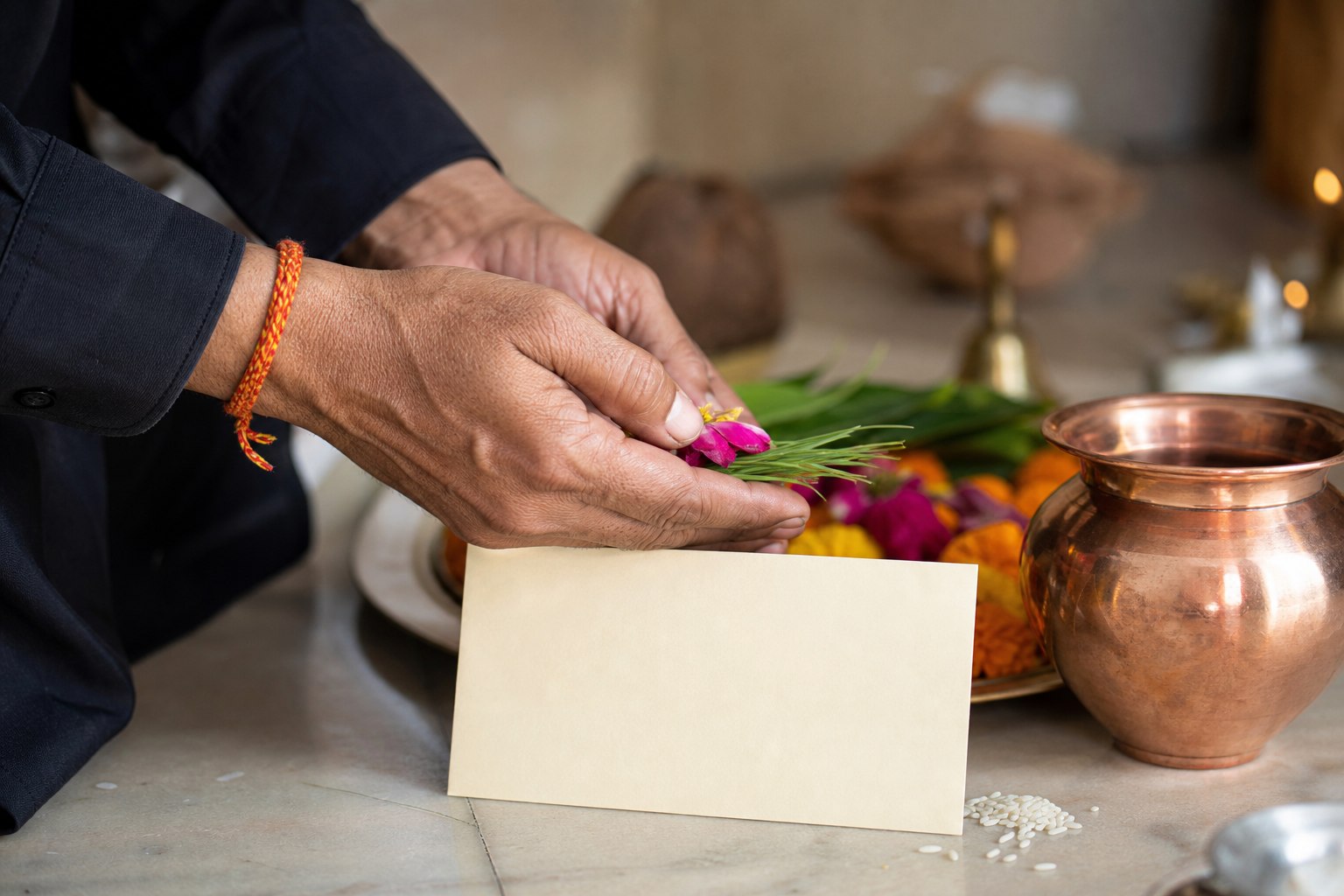
A remote Shani puja works by having pandits at a fixed location perform the full ritual on your behalf, reciting your name and gotra aloud during the sankalp, while you receive proof of what was done instead of attending in person. This single change, not travelling and not needing a priest to travel to you, removes a real cost that shows up in almost every in-person quote.
This matters for cost because it strips out the two most variable line items in the wider market: travel and venue. You are not paying a pandit's transport to reach you, and you are not paying extra because a puja happened at a particular famous site. What is left is the priest's time, the ritual materials, and the documentation, which is also why remote pricing tends to stay more consistent than in-person pricing, which shifts with distance, city, and the specific temple involved.
If you have ever wondered whether a temple visit is even necessary for this kind of remedy, you do not strictly need to visit a Shani temple to have a puja performed correctly on your behalf, though a visit certainly has its own value if it is available to you.
Shani Seva's Shani Puja Pricing, Tier by Tier
Notice that the family tier, at just over four times the individual price for up to six people, works out to well under the per-person cost of booking six individual pujas separately. That is the group-size effect described earlier, made concrete. It is also a fair test of whether a provider's pricing logic actually holds up once you check the maths rather than just reading the headline number.
What the Add-On Sevas Cost, and Whether You Actually Need Them
Gau Seva means feeding cows, a form of charity traditionally associated with Saturn. Deep Seva is an additional lamp offering beyond the one already included in the core puja. Anna Seva is a food offering, again a charitable act rather than a ritual requirement. An extra Til Tel Abhishek simply repeats the sesame-oil anointing a second time within the same booking.
None of these are required for the puja to be complete. They exist because some devotees want to combine ritual worship with an act of charity, which is itself a well-established part of how Shani Dev is traditionally honoured. If you are deciding what to offer beyond the core ritual, a look at what to offer Shani Dev on a Saturday or the full samagri list is more useful than assuming more add-ons automatically means a stronger outcome.
How to Tell If a Puja Provider's Price Is Actually Transparent
A transparent puja provider states the full price before you pay, itemises what that price includes, and does not add unexplained charges after you have committed. That sounds obvious, but it rules out a surprising number of listings you will find when searching for a Shani Shanti puja online.
Look for a written breakdown of what the base price covers: which mantras, how many priests, whether samagri is included, and what proof you receive afterward. According to Gopuja's own pricing page, puja providers that price clearly tend to separate the base ritual cost from optional add-ons explicitly, rather than folding everything into one vague number. That same separation is why the add-on sevas above are listed individually instead of bundled invisibly into a single higher figure.
A genuinely transparent provider also tells you what you get as proof of performance. For an in-person puja that might be your own attendance. For a remote one, it should be something concrete, not a vague promise that "the puja was done." A digital Seva Record and a video within a stated timeframe are the kind of specifics that separate a transparent booking from one where you are simply asked to trust the invoice.
Warning Signs of Hidden or Inflated Costs
The clearest warning sign is a provider who will not quote a full price before you call or message them. If a website lists a puja but asks you to "contact for pricing" with no range at all, that is a decision to withhold information that costs nothing to share, and it usually means the number gets adjusted based on how you sound on the phone rather than what the ritual actually requires.
A second warning sign is language that ties the price to the severity of your problem. Claims that a "strong Sade Sati" or a "severe dosha" requires a larger, costlier package are not how planetary influence in Vedic tradition actually works. Sade Sati and Shani Dosha are understood as periods and placements to navigate with steady conduct and sincere practice, not conditions with a price tag attached to their intensity. If you want the grounded version of what these actually mean astrologically, see Sade Sati meaning and Shani Dosha meaning and effects.
A third warning sign is pressure to add remedies beyond the puja itself, particularly expensive ones, framed as urgent or non-negotiable. A gemstone recommendation that arrives attached to fear about what will happen if you do not buy it immediately is worth stepping back from. If you are curious about gemstone remedies specifically, Neelam and blue sapphire benefits and Shani ring benefits are worth reading on their own terms, away from any sales conversation, so you are evaluating the idea rather than reacting to urgency.
Borrowing money or stretching well beyond your means for a ritual is not the point of devotion, and no legitimate tradition asks that of you. A sincere, modestly priced puja performed with attention is not a lesser version of a costlier one. It is simply a puja performed at a cost that matches what was actually done.
Is a More Expensive Puja More Effective?
There is no traditional basis for believing that a higher price makes a puja more effective, since effectiveness in Vedic practice is tied to sincerity, correct procedure, and consistency rather than the rupee amount spent. A correctly performed Til Tel Abhishek with proper Sankalp costs the same in ritual terms whether one pandit does it quietly or five do it with elaborate additions.
What can genuinely change with a larger or costlier package is scale: more mantra repetitions, a longer Homa, additional priests chanting in rotation for a longer period. Whether that scale matters to you is a personal and traditional question, not a factual one, and different families reasonably hold different views on it. What is not reasonable is a provider implying that a basic package will not "work" while a costlier one will, since that framing treats belief as a transaction rather than a practice.
If you are weighing whether to do this yourself instead of booking any provider, that is entirely a valid path too. Shani puja can be performed at home with the right vidhi and intent, and the step-by-step Shani puja vidhi covers exactly how. For ongoing practice beyond a single booked puja, how to please Shani Dev and Sade Sati remedies go into the daily and weekly habits that matter more, over time, than any single ceremony's price tag.
Conclusion
A transparent provider states its full cost upfront, itemises what it covers, and gives you concrete proof of what was performed. A provider that will not quote a price, or that ties cost to how "severe" your problem is, is telling you something worth listening to before you pay anything.
Live prices from our booking system
Current Shani seva prices
These figures are read directly from the active Laravel price book. The amount shown during booking is calculated again by the server before payment.
Personalised Shani Dev Puja
- Personal Shani Dev Puja 1 devotee
- £21.00
- Shani Dev Puja for two 2 devotees
- £32.00
- Shani Dev Puja for three 3 devotees
- £43.00
- Family Shani Dev Puja 4 to 6 devotees
- £51.00
Complete Saturday seva
- Complete Shani Saturday Seva 1 devotee
- £51.00
- Complete Family Shani Saturday Seva 2 to 6 devotees
- £101.00
Individual additional sevas
- Peepal Deepdaan£5.00
- Ant Feeding£5.00
- Black Dog Feeding£11.00
- Gau Seva£11.00
- Anna Seva£11.00